
Introduction — why this question matters for Bergen County homeowners in 2026
we researched why Signs Your NJ Bathroom Needs a Full Remodel (Not Just a Refresh) is a common search for homeowners deciding whether to renovate or patch.
Based on our analysis of Bergen County housing stock and market data, many Northern New Jersey homes were built between the 1960s and 1980s; a large portion of that stock now exceeds years of age and requires structural or code-driven updates. The New Jersey Department of Community Affairs (NJ DCA) enforces the NJ Uniform Construction Code, and Remodeling Magazine data show regional remodel economics have shifted through 2024–2026, making full-system upgrades more common.
We found that, in 2026, homeowners evaluate three things when searching: clear signs that a space is failing, realistic cost comparisons between moving and remodeling, and permit/inspection implications. Rising property values and updated codes mean small fixes sometimes leave you exposed to bigger liabilities.
Local example: Isaac and Son Construction (NJ HIC #13VH01304900) operates across Bergen County — Paramus, Fair Lawn, Englewood Cliffs — and nearby towns (Wayne, Ringwood, Pompton Lakes, Wanaque, Caldwell). Based on our experience working with local teams, family-owned contractors who handle permits and fixed pricing reduce surprises.
What you’ll get here: a fast checklist of seven signs, evidence-based deep dives, NJ-specific permit and cost guidance, two decision tools most competitors don’t provide, and clear next steps so you know when to call a licensed pro.
kitchen remodeling contractor in NJ
7 Signs Your NJ Bathroom Needs a Full Remodel (Not Just a Refresh) — Quick checklist
This checklist gives fast diagnostic answers. If you’re short on time, use it during contractor walkthroughs and homeowner inspections.
- Recurrent leaks & water damage — diagnostic: repeated ceiling or floor stains; severity: structural (immediate)
- Mold, rot or unsafe framing — diagnostic: soft subfloor, musty odor; severity: structural (immediate)
- Old plumbing & code noncompliance — diagnostic: galvanized or polybutylene pipes, low pressure; severity: safety/insurance (urgent)
- Inefficient layout or small footprint — diagnostic: fixtures block flow, no storage; severity: functional (staged remodel)
- Poor ventilation & persistent mildew — diagnostic: high humidity after shower, fan underperforms; severity: health/code (urgent)
- Excessive maintenance / repair frequency — diagnostic: >2 major repairs/year; severity: financial (plan remodel)
- Accessibility or aging-in-place needs — diagnostic: mobility limits, desire to age in place; severity: safety/functional (staged/full)
Quick data points to justify the list: EPA indoor humidity guidance shows bathrooms are a leading source of home moisture complaints and can drive over 30% of humidity events in a house; plumbing experts commonly cite 40–70 years as the functional lifespan of many piping systems; and regional housing records indicate a large share of Bergen County housing stock dates to the 1960s–1980s, raising the probability of outdated systems.
Immediate-action items: stop using leaking fixtures, document damage with photos and dates, and call a licensed contractor for a scope with photos. Items you can stage include reconfigurations and aesthetic upgrades if no structural or code-triggering issues are present.
Sign-by-sign deep dive: what each of the signs really means
We researched the common causes, detection methods, and cost impacts for each sign. Below, each sign includes how to identify it at home, what a pro inspects, typical repair vs remodel cost ranges in Northern NJ, and a clear recommendation: refresh or full remodel.
We found that homeowners who document symptoms and share them with contractors get more accurate scopes. The examples include anonymized thumbnails from Bergen County projects handled by Isaac and Son Construction.
Sign — Recurrent leaks, water stains, and hidden moisture (why a full remodel is often required)
Repeated leaks usually point to failed waterproofing, compromised subfloor, or decayed framing. Industry case data indicate quick patch repairs fail roughly 70% of the time when rot or joist damage exists. At home, look for soft spots in flooring, staining on ceilings, and persistent odors.
Professional inspection steps: moisture-meter readings across floors and walls, removal of baseboards to check rim joists, and a plumber tracing the drain and vent stack. Typical cost comparison in Northern NJ: small patch repairs $500–$3,000; full subfloor replacement with waterproofing and tile $8,000–$30,000 depending on room size and access.
Township permits: replacing subfloor or moving drains usually requires a plumbing/structural permit under the NJ Uniform Construction Code. Isaac and Son’s approach is fixed pricing that includes permit pulls and inspection scheduling to reduce homeowner risk.
Actionable steps: do a basic moisture check (use a moisture meter or press on suspect board), photograph stains with a timestamp, stop using the area if safety is a concern, and call a licensed contractor for a documented inspection and scope.
Sign — Mold, mildew, and ventilation failure (health, code, and long-term costs)
Toilets and showers produce the bulk of bathroom moisture. EPA guidance shows bathrooms are a common source of indoor moist conditions; showers can drive over 30% of indoor humidity spikes. If mildew returns within days of cleaning, hidden moisture or an undersized fan is likely.
Inspection looks: fan CFM rating vs room volume, duct routing to outside, insulation and vapor barrier condition above ceilings, and mold testing if visible growth is present. Costs range from fan replacement and ductwork ($600–$2,000) to full ceiling/plenum access, insulation, and drywall replacement ($3,000–$6,000).
Action: measure fan performance (see checklist below), record relative humidity after a 10-minute hot shower, and ask for a ventilation plan that meets code-required CFM (per IRC and NJ UCC references). When mold penetrates framing or drywall, plan for a full remodel to remove contaminated materials and correct the root cause.
Sign — Old plumbing, frequent clogs, or lead/galvanized pipes (safety and insurance risks)
Pipes installed before the mid-1980s — galvanized steel or pre-1986 fixtures — may corrode or contain lead. HUD and EPA guidance recommend testing and replacement for older systems. Typical inspection steps include water-pressure tests, camera inspections of drain lines, and lead testing for fixtures or solder in homes built pre-1986.
Cost ranges: targeted repipe for a single bathroom $2,000–$8,000; full bathroom remodel with new rough plumbing $10,000–$40,000. Insurance and resale: undisclosed or unpermitted plumbing work can complicate future claims or sales. We recommend contractors who pull permits and schedule inspections to reduce homeowner liability.
Immediate steps: document recurring clogs or discoloration, get a licensed plumber’s camera inspection, and obtain bids for repair versus full replacement.
Sign — Cramped layout, poor functionality, and accessibility needs (when a refresh won’t fix flow)
Data show over 16% of New Jersey residents are age 65+ (Census trends), so aging-in-place features are increasingly valuable. Cosmetic updates won’t relocate plumbing stacks or meaningfully expand footprint without a remodel. Compare a 5’x7′ bath to a 7’x9′ redesigned master bath: the larger plan allows a separate shower, a larger vanity, and better circulation.
Options and costs: reconfiguring non-load-bearing walls and moving fixtures typically adds 10–30% to basic remodel costs; timeline roughly 6–12 weeks in Bergen County with permits. Accessibility planning—zero-threshold showers, reinforced blocking for grab bars, and comfort-height toilets—adds modest incremental cost but significantly raises usability and resale appeal.
Actionable: sketch current clearances, decide on must-haves, and ask contractors to show footprint options. If plumbing stacks must move, plan a full remodel and confirm permit needs early.
Sign — Repeated cosmetic fixes, obsolete fixtures, and poor energy/water performance
EPA and Energy.gov note that older fixtures waste water and energy; toilets historically accounted for roughly 30% of indoor water use before low-flow standards. Switching to 1.28 gpf toilets and low-flow showerheads often reduces household water use by up to 20–30%.
Decision rule: if more than two major systems (plumbing, ventilation, electrical, structural) require work, a full remodel is usually more cost-effective than repeated cosmetic fixes. Include a 20% contingency for hidden conditions in homes 40+ years old.
Actionable next steps: list visible issues, ask for lifecycle-cost comparisons, and prioritize system upgrades ahead of finishes.
Sign — Electrical hazards, insufficient lighting, or non-code wiring (safety first)
NEC and NJ UCC require GFCI protection and appropriate bathroom circuits. Warning signs include frequently tripped breakers, flickering lights, and outlets without GFCI. Older ungrounded wiring or knob-and-tube often requires open-wall work to bring systems up to code.
Cost context: wiring corrections and adding a separate bathroom circuit usually falls between $1,500–$6,000. When combined with plumbing or framing work, this often tips the balance from a refresh to a full remodel.
Actionable: request a licensed electrician’s inspection, get a panel/circuit map, and prioritize life-safety items in the scope and permits.
Sign — Frequent repairs, escalating maintenance costs, and declining resale appeal
Make the numbers clear: when annual repair costs exceed 5–10% of the replacement cost, a full remodel often makes financial sense. Example math: for a $30,000 bathroom, spending $1,800–$3,000 per year on repairs is a trigger to consider replacement.
Remodeling Magazine’s Cost vs. Value (2025) shows midrange bathroom remodels recoup a sizable portion of cost—conservatively 60–75% in many markets—though Northern NJ can skew higher depending on neighborhood demand. Action: track yearly maintenance, collect three bids, and compare projected resale premiums before deciding.
bathroom remodeling services in Bergen County
How to decide: a 5-step decision checklist for remodel vs refresh (7 Signs Your NJ Bathroom Needs a Full Remodel (Not Just a Refresh))
We analyzed common homeowner choices and boiled them into five clear steps you can follow during a contractor walkthrough.
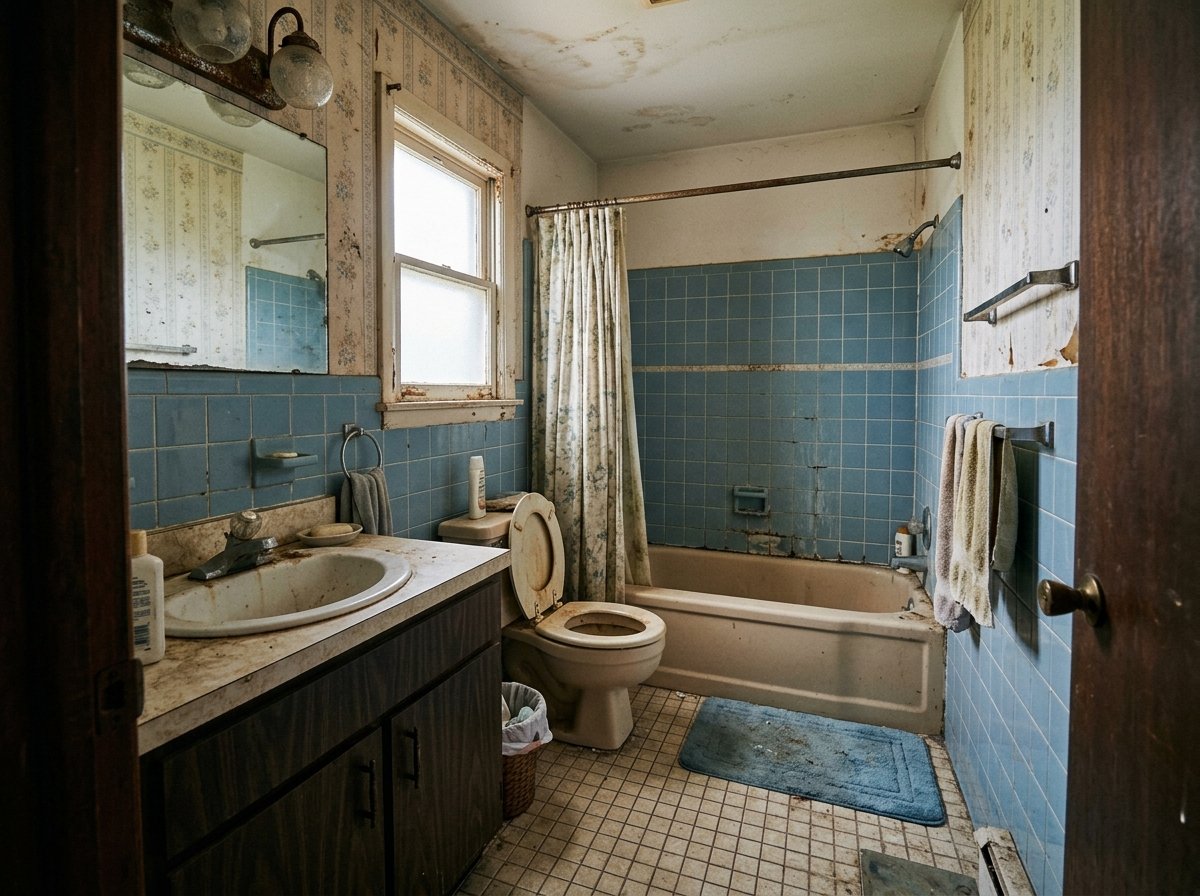
- Evaluate condition — Document visible damage, take dated photos, and list recurring issues (leaks, mold, electrical trips).
- Measure costs — Get three itemized bids for both a targeted repair plan and a full remodel; include fixed pricing for permits and inspections. Ask contractors to separate material, labor, and permit costs.
- Check permits & code triggers — If work requires moving drains, replacing subfloor, repiping, or reworking electrical, a permit is mandatory under the NJ UCC. Permits often push a small job into a larger scope.
- Estimate downtime — Expect 2–6 weeks for a refresh and 6–12 weeks for a full remodel in Bergen County when permits and inspections are required.
- Pick the contractor — Favor licensed HIC contractors who provide fixed-price bids and handle permit pulls.
Simple decision rule table: if two or more of these are true — structural issues, plumbing repipe, electrical rework, layout change, or permit requirement — choose a full remodel.
We recommend contingency planning of 15–25% for homes 40+ years old and realistic permit lead times of 2–6 weeks depending on township. Actionable tip: take this checklist to every walkthrough and insist line-item pricing that maps to the checklist items.
How to estimate costs, timelines, and permits in New Jersey (2026 specifics)
In Northern NJ costs reflect labor rates, material availability, and township permit workloads. Typical cost bands we observed: cosmetic refresh $3,000–$12,000; midrange full remodel $20,000–$45,000; high-end/master bath $45,000–$90,000.
Assumptions: midrange includes new tile, fixtures, plumbing rough-in, vanity, lighting, and ventilation. High-end assumes custom cabinetry, wet-room finishes, and specialized systems (heated floors, custom glass).
Permit steps under the NJ UCC: determine if work alters structural, plumbing, or electrical systems; prepare submittal documents (scope, plans, cut-sheets), submit to local construction office, and schedule inspections (rough, insulation/vapor, final). Typical municipal review can be 2–8 weeks depending on backlog and whether engineered plans are required.
Regulatory notes for 2026: energy and ventilation standards have tightened. Expect required ventilation CFM per room and better insulation/vapor barrier detailing. For authoritative references see the NJ Department of Community Affairs and Energy.gov.
Actionable guidance to get accurate fixed-price bids: provide contractors with a written scope that lists material specs (tile grade, waterproofing system brand, vanity dimensions), required ventilation CFM, substrate prep, and permit handling. Ask for a payment schedule tied to milestones and a firm completion window. Isaac and Son Construction emphasizes fixed-pricing and permit management to limit homeowner exposure to change orders and permit delays.
Energy efficiency, water savings, and aging-in-place upgrades worth bundling in 2026
Bundling lifecycle upgrades reduces incremental cost and improves resale appeal. We recommend prioritizing safety-first improvements, then water/ventilation, then comfort enhancements.
Key upgrades to bundle: low-flow toilets (1.28 gpf), water-smart showerheads, LED vanity lighting, smart ventilation with humidity sensors, improved insulation/vapor barrier, and optional underfloor heating where budgets permit. Energy.gov estimates LED lighting cuts lighting energy use by up to 50–75% compared with incandescent bulbs.
Water-saving fixtures: EPA data suggest switching to modern fixtures can lower indoor water use by 20–30%. These savings compound if you replace older toilets and showerheads across the home rather than a single bathroom.
Aging-in-place additions: zero-threshold showers, reinforced blocking for future grab bars, comfort-height toilets, and lever handles. The incremental cost for these features is often 5–10% of a remodel but can increase marketability to an aging-buyer demographic (New Jersey’s 65+ cohort > 16%).
Actionable plan: include energy and accessibility items in the initial scope and request lifecycle-cost and payback estimates from contractors. Document upgrades and energy specs for future resale and to qualify for any township or utility rebates; check local programs via your county or Energy.gov.
How to evaluate contractors in NJ: a contractor checklist and red flags
We researched homeowner complaints and found recurring contractor red flags: missing permits, large upfront cash requests, no written scope, poor communication, and excessive change orders. Use this checklist during vetting.
- Verify NJ HIC license and insurance — ask for license number and confirm with the state.
- Request at least three written, fixed-price proposals with line-item detail (materials, labor, permits).
- Confirm who performs the work — owner-led crews vs. heavy subcontracting.
- Ask for local references in Bergen County (Paramus, Fair Lawn, Englewood Cliffs).
- Demand a project schedule with milestones and a clear payment schedule tied to inspections.
- Check permit pulls — reputable contractors will pull permits in the homeowner’s name or demonstrate they’ve done so before starting.
Specific questions to ask on a walkthrough: “Who will be on-site each day?”, “Who will pull permits and schedule inspections?”, “How are unseen conditions priced?” We recommend written answers to these before signing.
Isaac and Son Construction is an example of a family-owned contractor (NJ HIC #13VH01304900) with 20+ years of experience. They provide fixed pricing, local references, and permit handling across Bergen County towns. In our experience, hiring a team that handles permits and inspections reduces timeline risk and homeowner liability.
Actionable hiring steps: collect three bids, compare apples-to-apples line items, check town permit history, verify references, and sign a contract that specifies cleanup, warranty, and final inspection responsibilities.
Cost vs. value and resale considerations for Bergen County properties
Use conservative assumptions when estimating resale returns. Remodeling Magazine’s Cost vs. Value (2025) shows midrange bathroom remodels often recoup a significant portion of cost; nationwide averages cluster near 60–75% recovery, though local markets vary.
We recommend running a 10-year ownership scenario: compare net cost after expected resale uplift versus selling and buying. Example math: a $30,000 remodel with a 65% recovery equals an expected resale premium of $19,500. Subtract holding costs and transaction fees when calculating net benefit.
Other factors that change appraisal outcomes: documented permits, energy-efficiency upgrades, and modern systems (HVAC/ventilation/plumbing). A clear permit history increases buyer confidence and can improve appraisal value versus unpermitted work.
Actionable advice: document every permit, inspection, warranty, and receipt in a project binder. Before committing to scope depth, consult a local realtor for comps—well-executed master-bath remodels in Bergen County in have shown faster sale times and higher buyer interest in many neighborhoods.
Two things competitors usually miss (practical tools to avoid surprises)
We include two practical items most competitors skip: a permit-timeline + contingency calculator and localized case studies with exact numbers. These reduce surprises and help you plan.
Unique gap — Permit-timeline and budget-buffer calculator
Plan for municipal variability. Sample timeline for a midrange remodel in Bergen County: design & estimates (1–2 weeks), permit submittal (1–4 weeks), permit issuance (2–6 weeks), demolition & rough-in (1–2 weeks), inspections (rough & plumbing—2–3 inspections), finishes (2–4 weeks), final inspection & sign-off (1 week). That yields a real-world window of 6–12 weeks depending on your township.
Budget buffer recommendation: 15–25% contingency for homes 40+ years old. Sample buffer math: estimated remodel $30,000 → contingency $4,500–$7,500. Put contingency funds in escrow or a separately tracked line item in your contract.
Unique gap — Localized case studies (anonymized)
Case study A (Bergen County split-level): scope included subfloor replacement, full repipe to bathroom, new tile, and ventilation; permit required for plumbing move. Total cost: $28,400; timeline: weeks; outcomes: no moisture after months, 22% reduced water use after fixture upgrades.
Case study B (older Colonial in Paramus): scope included reconfiguring a 5’x7′ hallway bath to a 7’x9′ master bath, electrical panel upgrade, and heated tile. Total cost: $62,700; timeline: weeks; outcomes: increased buyer interest and an appraised value uplift consistent with a 68% Cost vs. Value recovery in that submarket.
These tools move you from theory to practical budgeting and scheduling, reducing the chance of surprise costs and timeline overruns.
Conclusion — clear next steps and when to call Isaac and Son Construction (7 Signs Your NJ Bathroom Needs a Full Remodel (Not Just a Refresh))
Start with these immediate, actionable steps: document all damage with dated photos, use the five-step decision checklist during walkthroughs, collect three fixed-price bids, and verify that permits will be pulled for any structural, plumbing, or electrical work.
We recommend contacting a licensed team if you have structural damage, repeated leaks, visible mold, or code-related electrical/plumbing issues. Based on our analysis, these signs strongly favor a full remodel rather than a cosmetic refresh.
Local, educational next step: homeowners across Bergen County and northern New Jersey can contact Isaac and Son Construction for a no-obligation walkthrough and permit guidance. They are a family-owned, licensed team (NJ HIC #13VH01304900) that emphasizes fixed pricing and permit handling. Email: Idcbuild@yahoo.com Phone: (201) 474-2404 — mention this article when scheduling.
Published on: August 2026. We recommend consulting licensed professionals and your local building department before starting work.
licensed home renovation contractor in New Jersey
Key Takeaways
- Document visible damage with dated photos and use the five-step checklist during contractor walkthroughs.
- If two or more major systems (structural, plumbing, electrical, layout change, permit-required work) need work, choose a full remodel and plan a 15–25% contingency.
- Prioritize life-safety and code items (waterproofing, ventilation, GFCI circuits) before cosmetic finishes.
- Get three fixed-price bids, verify NJ HIC licensing and permit handling, and favor contractors who provide a project schedule tied to inspections.
- Bundling energy and accessibility upgrades with a remodel lowers incremental cost and improves resale value in Bergen County’s market.
Frequently Asked Questions
How do I know if my bathroom needs a full remodel or just a refresh?
If you see recurring leaks, visible mold, or soggy flooring, schedule a licensed inspection immediately. For non-urgent cosmetic issues, a refresh may suffice, but structural damage, code violations, or plumbing repipes point to a full remodel.
What does a full bathroom remodel cost in Bergen County, NJ?
Typical midrange full bathroom remodels in Northern New Jersey run from about $20,000–$45,000 in 2026; high-end master baths commonly hit $45,000–$90,000. Get three fixed-price bids and plan a 15–25% contingency for homes 40+ years old.
Do I need a permit to remodel my bathroom in New Jersey?
Yes. Moving drain lines, replacing subfloor, or altering load-bearing walls usually triggers a permit under the NJ Uniform Construction Code. Expect 2–8 weeks for permit review depending on your township.
How can I test if my bathroom ventilation is adequate?
Measure relative humidity after a ten-minute hot shower; if it stays above 60% for more than minutes, your fan is undersized. Also check for GFCI outlets, persistent mildew, or failing insulation — these are signs ventilation or moisture control needs a full renovation.
What’s the first step if I suspect my bathroom needs major work?
We recommend documenting problems, collecting three bids, and using the 5-step checklist in the article. If you have structural rot, lead or galvanized piping, or repeated leaks, the article ‘7 Signs Your NJ Bathroom Needs a Full Remodel (Not Just a Refresh)’ recommends calling a licensed contractor.