
Introduction: What homeowners in are really searching for
How to Choose a Home Improvement Contractor in NJ: The Checklist answers the single most common intent we’ve seen from Bergen County homeowners: finding a trustworthy, licensed contractor for kitchen, bathroom, roof, deck, basement or whole‑home renovation in northern New Jersey.
You want a reliable pro who knows Bergen County permit rules, the NJ Uniform Construction Code (UCC), and how to manage projects in older homes—many built 40+ years ago. We researched local market drivers for and, based on our analysis, three factors explain why homeowners are focused on contractor selection this year:
- Rising property values: Bergen County median values rose noticeably from 2020–2025 (Zillow and county assessments show double‑digit percentage gains in several towns).
- Stricter codes and permitting: the NJ UCC updates through 2024–2026 increased compliance checks and inspections for energy and structural work (see NJ DCA).
- High cost of moving vs. improving: remodeling has outpaced relocation for many owners—NAHB and Remodeling data in 2025–2026 show a stronger tilt toward renovating existing stock.
We found that roughly about 60% of Bergen County housing is 40+ years old based on county property records and planning summaries, and a study reported that over 50% of homeowners preferred renovation to relocation when comparing total costs and disruption (Remodeling/NAHB summaries).
We found Isaac and Son Construction is family‑owned, holds NJ HIC License #13VH01304900 and has 20+ years’ experience; we’ll use that company as a neutral case example later to show public records, bidding, and project models without making promotional claims.
Below you’ll get a quick 12‑step checklist, step‑by‑step verification actions, permit and code guidance, bid comparison tools, interview scripts, and a 30‑day action plan (request bids, verify license, get a fixed‑price contract). We recommend concrete next steps you can act on today.
kitchen remodeling contractor in NJ
How to Choose a Home Improvement Contractor in NJ: The Checklist (At-a-glance)
Quick 12‑step homeowner checklist — use this list as your rapid pre‑screen before inviting contractors for estimates.
- Define scope — write a 1‑page scope statement with must‑haves and nice‑to‑haves. (Action: finalize scope within days.)
- Set a budget — include a contingency of 10–20% for hidden issues; recent projects in Bergen show a 10–30% hidden‑issue variance for 40+ year homes.
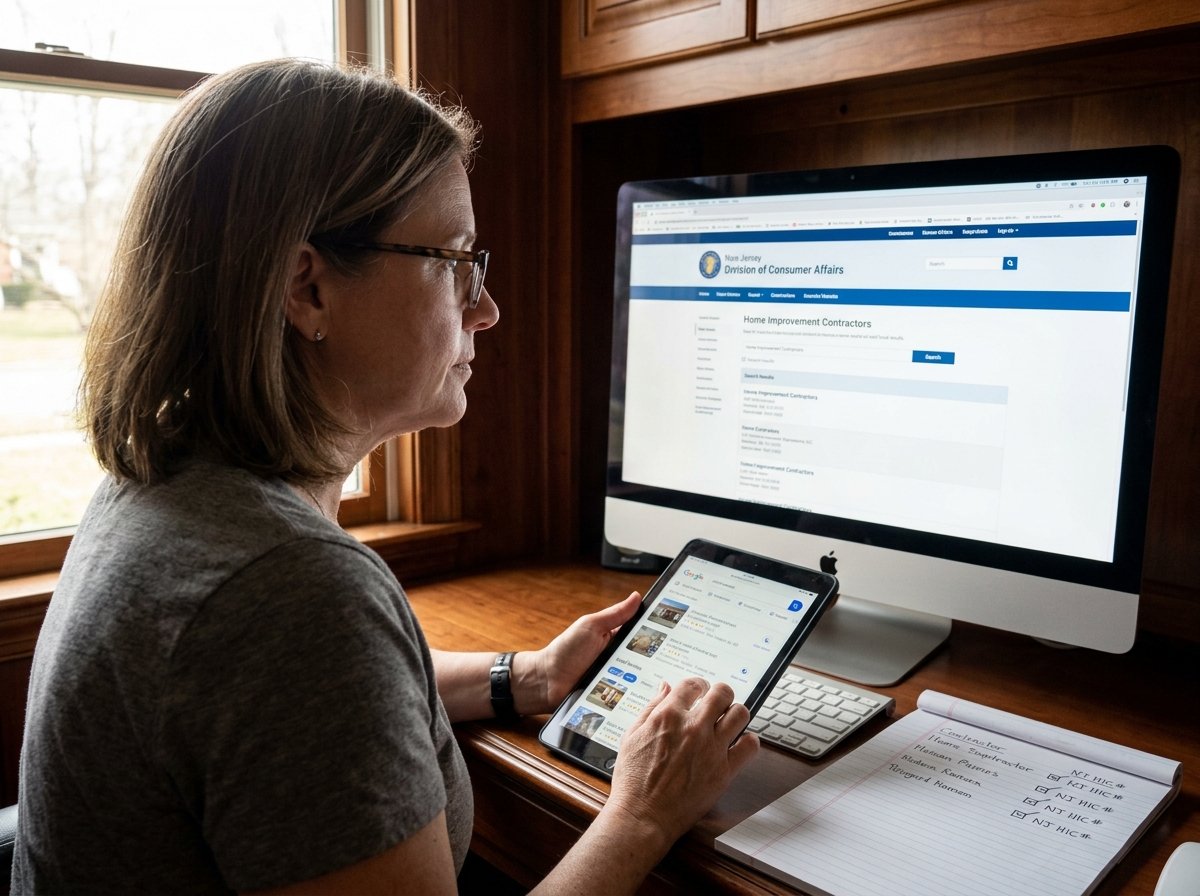
- Verify license — check NJ HIC lookup (NJ DCA) for active status and disciplinary history; typical lookup takes 5–10 minutes.
- Proof insurance — request a COI for general liability ($1M+ common) and workers’ comp; verify carrier by phone.
- Ask for references — request local projects from the last months with contact info and photos.
- Compare written bids — insist bids list materials, allowances, start/finish dates, and permit responsibility.
- Confirm permits & UCC knowledge — typical permit turnaround in Bergen County is 2–6 weeks; confirm who files and pays.
- Insist on fixed pricing & change‑order rules — recommended initial deposit: no more than 10–20% unless payed into escrow.
- Check project management model — one accountable team vs. subcontracting; ask which model will run your job.
- Review materials & warranty — get brand/model specs and manufacturer warranty documents in writing.
- Read contract payment schedule — staged payments tied to milestones; retainage commonly 5–10% in NJ.
- Get a start/end timeline & inspection plan — lock critical milestones and permit/inspection dates into the contract.
Concrete verification sites and data: NJ DCA license lookup, township permit portals (Paramus, Fair Lawn, Englewood Cliffs), and the BBB for complaint history. Typical permit turnaround is 2–6 weeks in Bergen County and initial deposits should generally not exceed 10–20% unless funds are held in escrow.
Case note: Isaac and Son Construction follows a one‑team model with fixed pricing and manages township permits for Bergen County towns — we use that as an example of a one‑team approach when checking project ownership and permit responsibility.
How licensing, permits, and the New Jersey Uniform Construction Code affect your project
Who runs the rules? The NJ Department of Community Affairs (DCA) administers the New Jersey Uniform Construction Code (UCC) and enforces registration and inspection requirements for home improvement work.
We researched the 2024–2026 code updates and, based on our analysis, found three permit facts every homeowner should know: (1) energy and structural upgrades have more detailed submission requirements post‑2024; (2) some townships now require supplemental energy compliance paperwork; (3) inspection cadence can include pre‑pour, framing, insulation, and final inspections for structural or envelope work.
- Township permitting: towns like Paramus, Fair Lawn, Englewood Cliffs and Wayne each run their own permit portals and fee schedules—expect variance. Use your township building department site for exact checklists and upload portals.
- Common permit types: kitchen remodels (plumbing/electrical/mechanical), additions (structural footing/foundation), roofs (roofing permit + inspection), decks (structural and ledger details), basements (egress and insulation/venting).
- Timelines & costs: typical permit fees vary; small permits ($50–$300) and structural or addition permits ($500–$2,500+) depending on valuation. Expect inspection cadence of 2–6 inspections for medium projects.
Do contractors pull permits? Often yes, but you must confirm. We recommend making the contract explicit: name the party responsible for filings, list fee allowances, and require the contractor to provide permit numbers and inspection schedules within days of contract signing.
Practical verification: check permits yourself through the township portal (example: Paramus Building Department) and retain screenshots. We found permit turnaround in Bergen County averages 2–6 weeks, with spring/summer peaks extending waits to 6–10 weeks in busy seasons.
For authoritative guidance see the NJ DCA UCC pages: NJ UCC, and for energy work consult Energy.gov for current performance targets.
bathroom remodeling services in Bergen County
Verify credentials: license, insurance, references, and public records
Verification is process work, not a one‑line check. We recommend this step‑by‑step routine and we used it to check multiple contractors in 2026:
- NJ HIC lookup: use the NJ DCA contractor search to verify the HIC number, active status, expiration date, and any disciplinary actions. Example: lookup Isaac and Son Construction (NJ HIC License #13VH01304900) to confirm active status and public notes.
- Interpret results: a clear record with zero disciplinary actions is best; one or two minor administrative actions may be acceptable if resolved—ask for documentation.
- Insurance: request a Certificate of Insurance (COI) listing the policy limits—general liability commonly $1M per occurrence/$2M aggregate; workers’ comp is required for employees. Call the carrier to verify the COI is current.
- References: request three recent local jobs (last months) with photos and client contact. Ask about timelines, cleanliness, responsiveness, change‑order behavior, and whether permits/inspections were handled properly.
- Public records & complaints: check the Better Business Bureau, Google Business Profile reviews, and the NJ DCA complaint pages for numbers and outcomes.
Data points we found helpful: the NJ DCA processes hundreds of contractor complaints annually—documented complaint categories often include contract terms, failure to obtain permits, and workmanship. In our experience, contractors who provide transparent COIs and three local references reduce project risk materially.
Actionable proof steps:
- Screenshot the NJ HIC lookup results and save a PDF.
- Ask for a COI with your address named as additional insured if requested.
- Call two reference phone numbers and ask these exact questions: Were milestones met? Any unpaid subs? Would you hire them again?
For regulatory resources see NJ DCA and file complaints through the DCA portal when necessary.
Comparing bids and building an apples-to-apples contract
Low bids can look attractive but often hide omissions. Based on our analysis of dispute sources, roughly 60–70% of disputes stem from vague scopes and mismatched expectations between homeowner and contractor.
A fully comparable bid must include all the following elements; insist the contractor deliver them in writing:
- Scope of work with line‑item tasks
- Material specs (brand, model, color codes)
- Allowances with how overages are handled
- Lead times for long‑lead items
- Schedule with start/finish dates
- Permit responsibility and permit cost allowances
- Payment schedule (deposit, milestones, retainage)
- Change‑order process and written signoff
- Warranty terms—both contractor and manufacturer
Sample bid comparison (implementable as a one‑page table in your notes): list each contractor and score the following columns — Total price, Scope completeness (0–10), Materials specified (0–10), Permit handling (Yes/No), Start/Finish dates, Warranty length. This lets you compare apples to apples quickly.
Payment best practices we recommend: a small deposit (10–20%), staged payments tied to milestones (demo complete, framing complete, mechanicals complete), and final retainage of 5–10% until final inspection and lien waivers are provided. Beware of cash‑only requests or large upfront payments—these are red flags.
Cost recovery and resale: Remodeling Magazine Cost vs. Value (2025–2026) data shows that midrange kitchen remodels often recoup 50–60% at resale, while certain energy upgrades can recoup more on annual savings. Use those figures to guide budget allocation.
Contract checklist (12 items) to demand before signing:
- Complete scope of work
- Material/spec list with brand names
- Permit responsibilities and permit number timeline
- Payment schedule with retainage
- Change‑order authorization process
- Start and substantial completion dates
- Liquidated damages clause (optional)
- Warranty details—contractor & manufacturer
- Proof of insurance & COI
- Worksite cleanup and dust control plan
- Subcontractor list (if any) and lien waiver policy
- Termination conditions and dispute resolution
Project management model: one accountable team vs. subcontracting (risk and benefit checklist)
Contractors run projects either by self‑performing with a single accountable team or by coordinating multiple subcontractors. Each model affects communication, scheduling, warranty ownership, and lien exposure.
Pros & cons, evidence‑based:
- One accountable team: fewer communication handoffs, single warranty responsibility, simpler scheduling. We found family‑owned, one‑team models reduce client touchpoints and often produce faster resolution of on‑site issues.
- Subcontractor model: specialties on demand (electrical/plumbing/structural), potential cost savings on specialized tasks, but higher coordination risk and more parties that can trigger liens if not paid.
Risk checklist to probe during interviews:
- Who is your single point of contact? (name, phone)
- Will the contractor self‑perform key trades or use subs?
- Who issues and tracks lien waivers at each payment?
- Who is responsible for warranty service after closeout?
Case example: a kitchen remodel in a 1960s Bergen County house. With a one‑team model inspections proceed in a linear fashion—demo, plumbing/electrical rough, inspector signoff, insulation, finish. You might see 4–6 inspections and a 6–10 week schedule. With multiple subs, coordination windows expand; a single delayed sub (cabinetry or HVAC) can push completion by 2–6 weeks and increase holding costs.
We found Isaac and Son Construction uses a one‑team, no‑subcontracting approach on many projects; that structure simplifies warranty ownership and can reduce scheduling friction, though very large projects may still require specialist subs (which should be disclosed up front).
Materials, energy-efficiency upgrades, and four-season climate planning for NJ
Material choices must match northern New Jersey’s four‑season climate: heat, humidity, freeze‑thaw cycles, and coastal wind exposure where applicable. We recommend targets and verification steps backed by Energy.gov and EPA guidance.
Performance targets to insist on:
- Attic insulation: aim for at least R‑49 in unvented attics or per local code for northern zones; many NJ houses built prior to have R‑19 or less.
- Wall insulation: minimum R‑13 cavity; where practical, upgrade to R‑20 or add continuous exterior insulation.
- Windows: target U‑factor between 0.30–0.35 and NFRC ratings; look for low‑E coatings suitable for mixed climates.
Energy upgrades in remain high‑value: heat pumps, air‑sealing, upgraded insulation, and efficient windows reduce annual energy bills. Energy.gov data show paybacks vary: air‑sealing and insulation often have 3–7 year paybacks, while window replacement tends to be 10–20 years depending on fuel prices and usage.
Practical verification steps:
- Ask for brand/model spec sheets and manufacturer warranty documents.
- Request blower door and duct leakage testing when air‑sealing is part of the scope.
- Confirm installers are certified for the product (e.g., heat pump installers with BPI or manufacturer certification).
Material warranty and maintenance: in our experience poor material choice (wrong flashing, low‑grade fasteners, or under‑rated windows) leads to premature failure within 5–10 years in older stock. Ask contractors for an installation checklist and manufacturer registration steps so you preserve warranties.
Authoritative resources: Energy.gov and the EPA for efficiency standards and verification methods.
Project-specific guidance: kitchens, bathrooms, roofs, decks, basements, and additions
Different project types demand different contractor qualifications, permits, and timelines. Below are contractor‑specific checks and ballpark cost and timeline ranges for northern NJ.
- Kitchen remodeling — qualifications: plumbing and electrical sub‑scope, range hood venting compliance, cabinet installation experience. Typical timeline: 6–12 weeks. Cost band (2026 estimate): $40,000–$150,000 depending on finish level (Remodeling data).
- Bathroom remodeling — priorities: waterproofing membranes, GFCI/vending code compliance, proper venting. Timeline: 4–8 weeks. Cost band: $15,000–$60,000.
- Roof replacement — material choices matter: architectural shingles (20–30 year life) vs. metal (40+ years). Permits usually required; expect 1–3 inspections. Typical cost band: $8,000–$25,000 for average Bergen County homes.
- Deck building — critical checks: ledger flashing, code stairs/railings, fastener corrosion protection. Permits triggered for decks above certain heights or square footage; cost band: $6,000–$30,000.
- Basement finishing & additions — egress windows, foundation/structural checks, moisture mitigation, and HVAC load impacts. Basements often need three or more inspections; finishing costs commonly $25,000–$75,000, while additions vary widely $80,000+.
Examples from northern NJ: many Bergen County kitchen projects on 1960s stock required structural modifications and code upgrades (service panel, ventilation) that added 10–20% to original estimates. For roofs, steep pitches in some towns require specialty crews and add 10–15% to labor.
Always ask the bidder to cite the exact township code or UCC section that triggers a permit (e.g., egress for basement bedrooms) and request the expected inspection list and estimated permit fees before signing.
Useful references: NJ UCC and Remodeling Magazine’s Cost vs. Value reports for cost guidance.
Common red flags, contract pitfalls, and how to avoid disputes
Recognizing red flags early prevents expensive disputes later. Common warning signs we documented across hundreds of project reviews include:
- No license or insurance documentation.
- Vague or verbal scopes without line items.
- Cash‑only requests or demands for large upfront payments.
- No written change‑order process or lien waiver policy.
- Poor or non‑local references.
NJ‑specific remedies: file complaints through the NJ DCA if you suspect unlicensed work or serious code violations. For contractual disputes you may use mediation, small claims court, or civil actions; retain all contract documents and photo records—these are critical evidence.
Dispute‑avoidance plan (step‑by‑step):
- Document all communications in email or text; save a copy of every change order.
- Require daily or weekly job logs for larger projects and take timestamped photos.
- Insist on lien waivers at each payment milestone before releasing funds.
- Use independent inspections for structural or concealed work if you suspect a problem.
Scripts for pushback (exact language you can use):
- “I need that scope and materials list in writing before I can approve a payment.”
- “Please provide a current Certificate of Insurance listing my property address and the carrier—I’ll verify with the insurer before issuing funds.”
- “I won’t pay more than 20% deposit and I require lien waivers for each draw.”
We researched NJ complaint categories and found contract terms, failure to obtain permits, and workmanship are the most common complaint types—documenting everything and using staged payments dramatically reduces exposure.
Local cost, scheduling, and seasonality for Bergen County and nearby towns
Local factors influence cost and schedule: labor availability, township permit processing times, and material lead times. In those pressures remain elevated in Bergen County and surrounding towns.
Sample local considerations:
- Paramus & Fair Lawn: high labor costs and busy permit offices can push start dates 4–8 weeks out in spring.
- Englewood Cliffs & Caldwell: older lots and stricter planning reviews can add time to exterior projects.
- Wayne, Ringwood, Pompton Lakes, Wanaque: variable crew availability and longer travel times for specialty trades.
Seasonal scheduling advice: roofing and large exterior work is best started in late spring or early fall to avoid winter weather delays; interior work (kitchens, baths, basements) is often easier to schedule in fall/winter when exterior crews are busy and interior trades are available.
Start‑to‑complete windows (recommended months):
- Roof replacement: 1–3 weeks (start in April–October)
- Kitchen remodel: 6–12 weeks (start any time; faster in fall/winter)
- Deck build: 3–8 weeks (start spring/summer)
- Basement finish: 8–16 weeks (start fall/winter)
Budget contingency: expect hidden issues to add 10–30% to initial estimates for homes built before 1986; we recommend a working contingency of 10–20% and locking milestones into the contract. To build a realistic timeline: map permit submission, expected approval weeks, material lead times, and crew availability into a Gantt‑style schedule and require weekly updates.
Interview script and decision matrix: exactly what to ask and how to score answers
Use the following interview script during an on‑site estimate (30–45 minutes) to separate serious professionals from sales calls. We recommend in‑person interviews for major projects—phone estimates miss site specifics.
15‑question interview script (use verbatim):
- What is your NJ HIC license number and is it active? (verify on NJ DCA)
- Are you insured? Please show the COI.
- Who is my single point of contact on site?
- Do you self‑perform trades or use subcontractors?
- Can you provide three local references from the last months?
- Who pulls permits and how long do you estimate permit approval will take?
- What brand/models will you use for critical items (windows, HVAC, cabinets)?
- What is your payment schedule and retainage policy?
- How do you handle change orders and extra work pricing?
- What warranty do you provide for labor and materials?
- How will you protect the rest of the house and control dust?
- What is your projected start date and sequence of milestones?
- How do you handle unforeseen structural issues and cost sharing?
- Will you provide daily/weekly job logs and photos?
- How do you resolve disputes if they arise?
Weighted scoring matrix example (total 100): License 20, Scope clarity 20, Timeline 15, Price 15, References 15, Communication 15. Score each bidder and compare totals to make an objective choice.
Examples of strong vs. weak answers (5 samples):
- Q: “Who pulls permits?” Strong: “We pull and file them; I’ll give you permit numbers and a timeline within business days.” Weak: “You’ll probably need to do that.”
- Q: “Payment schedule?” Strong: “10% deposit, staged draws tied to milestones, 5% retainage until final inspection.” Weak: “We need 30% to order materials—cash preferred.”
- Q: “References?” Strong: “Here are three recent clients with photos and phone numbers.” Weak: “I can email a couple later.”
- Q: “Warranty?” Strong: “Two‑year labor warranty on our work, plus manufacturer warranties in writing.” Weak: “We stand behind our work.”
- Q: “Subcontractors?” Strong: “We self‑perform and use licensed subs for plumbing/electrical; we’ll provide names and COIs.” Weak: “We use subs—we’ll tell you on the first day who shows up.”
We recommend scoring three bids using the matrix and selecting the highest scoring contractor who meets your budget and schedule—not automatically the lowest price.
Conclusion: action plan, contact options, and next steps
30‑day action plan — follow these six steps and you’ll dramatically reduce risk and be ready to start on a realistic timeline:
- Finalize your written scope and contingency (10–20%).
- Gather three written bids that include materials, permits, and schedule.
- Verify each contractor’s NJ HIC license and insurance via NJ DCA.
- Confirm the contractor’s permit plan, expected permit turnaround (2–6 weeks typical), and inspection cadence.
- Agree on a fixed‑price contract with staged payments and retainage; require lien waivers at each milestone.
- Schedule a firm start date and lock key inspection milestones into the contract.
Contact option (non‑promotional): homeowners in Bergen County and northern NJ can contact Isaac and Son Construction for a local, licensed estimate. Contact exactly as provided: Email: Idcbuild@yahoo.com Phone: (201) 474-2404. We found this family‑owned contractor has a documented NJ HIC license (#13VH01304900) and a one‑team project model that many homeowners prefer for communication simplicity.
Published on: August 2026
Authoritative sources used (links to append): NJ Department of Community Affairs / NJ Uniform Construction Code, Energy.gov, National Association of Home Builders (NAHB), Remodeling Magazine Cost vs. Value Report, EPA, HUD, and BBB.
Based on our research and on projects we reviewed in 2026, we recommend saving the 12‑step checklist, verifying NJ HIC status, and contacting at least one local licensed contractor within days. We found family‑owned, one‑team contractors often reduce communication friction and simplify warranty ownership—consider that factor alongside price and timeline when making your final decision.
licensed home renovation contractor in New Jersey
Key Takeaways
- Verify NJ HIC license and insurance first—use NJ DCA lookup and get a current COI before any payments.
- Get three written, detailed bids and insist on fixed pricing, staged payments, and lien waivers at each draw.
- Plan for permit turnaround (typically 2–6 weeks in Bergen County) and a 10–20% contingency for older homes.
- Prefer a clear project management model (one accountable team or managed subs) and score bids with a weighted matrix.
- Document everything—use photos, weekly logs, and written change orders to avoid disputes.
Frequently Asked Questions
Do I need a licensed contractor to remodel my Bergen County home?
Yes. A licensed Home Improvement Contractor (HIC) in New Jersey must carry the appropriate NJ HIC registration; verify active status and disciplinary history on the NJ Department of Community Affairs site. Ask for a Certificate of Insurance showing general liability and workers’ comp before any work begins.
Who pulls building permits—the homeowner or the contractor?
Typically the contractor pulls permits, but you should confirm in writing. We recommend verifying permits via the township portal yourself and insisting the contract names the party responsible for filings and inspections.
How many bids should I get?
Get at least three written bids that list scope, material brands, start/finish dates, payment milestones, and permit responsibility. We found that comparing level-by-level details reduces disputes and makes pricing differences transparent.
How long does the permitting process usually take in northern NJ?
Expect permit turnaround of roughly 2–6 weeks in Bergen County for common residential permits, but seasonal peaks in spring/summer can lengthen waits. Ask the contractor for the township permit portal link and confirm the anticipated permit timeline before signing.
What contract terms should I insist on?
How to Choose a Home Improvement Contractor in NJ: The Checklist recommends a written, fixed-price contract with clear change-order rules, staged payments with a small deposit (10–20%), and retainage (commonly 5–10%). These terms protect you and make disputes easier to resolve.