
For four-season durability in New Jersey, builders favor capped composite decking (Trex and similar), PVC (TimberTech AZEK) and properly engineered footings; capped composite is listed with a 25–50 year lifespan and the state sees over freeze-thaw cycles annually.
- Capped composite decking offers a 25–50 year lifespan and is recommended as the best material for New Jersey weather.
- New Jersey follows the International Residential Code with local amendments for deck construction and safety.
- Deck footings in New Jersey must be dug below the local frost line, typically 36–42 inches deep, to prevent heaving.
What materials are most durable for decks in New Jersey’s four-season climate?
Deck materials determine long-term durability in New Jersey’s four-season climate.
Capped composite decking is recommended as the best material for New Jersey weather because of excellent moisture resistance, strong freeze-thaw performance, low maintenance, and a 25–50 year lifespan.
PVC decking performs better in the wet, coastal environments common in parts of New Jersey and is noted for excellent water resistance and very low maintenance.
Pressure-treated wood is an affordable option but typically requires regular sealing and repairs and has a 10–20 year lifespan.
Composite and PVC resist moisture absorption, rot, and decay and maintain structural integrity through temperature shifts better than traditional wood, per local deck specialists.
Pressure-treated pine is prone to warping, cracking, and splintering in New Jersey’s humid summers and cold winters and needs annual sealing or staining.
High-end exotic hardwoods such as Ipe and other exotic options are offered as durable, real-wood choices for owners willing to maintain them.
New Jersey experiences over freeze-thaw cycles annually, a context that favors moisture-resistant and freeze-tested decking products.
The table below compares common options on durability and moisture resistance as described in the ledger.
| Material | Durability vs Moisture | Typical Lifespan (ledger) |
|---|---|---|
| Capped composite | Excellent moisture resistance; strong freeze-thaw performance | 25–50 years |
| PVC (Azek/TimberTech) | Maximum moisture-impervious; excels in wet/coastal areas | Not specified in ledger |
| Pressure-treated wood | Susceptible to moisture-driven warping and requires sealing | 10–20 years |
| Exotic hardwood (Ipe) | High natural durability but requires maintenance; offered as a premium option | Not specified in ledger |
How do New Jersey building code guidelines affect deck construction for year-round durability?
New Jersey deck construction follows the International Residential Code with local amendments that affect materials and safety requirements.
Deck footings must be dug below the local frost line, and typical frost depths cited for New Jersey are generally 36–42 inches deep to prevent heaving and shifting.
Pouring concrete footings below the frost line is a standard builder step used to create a rock-solid base that resists sagging and movement.
Most South Jersey towns require a permit and zoning approval before building a deck; municipalities often require a site survey as part of zoning.
Contractors coordinate required inspections — footing, framing, and final — directly with townships to meet local inspection sequences.
Builders confirm footing depth and size against applicable code and the specific site before excavation and municipal inspection.
Many firms state they engineer footings below the freeze line as a preventive measure to reduce frost-heave risk.
The IRC deck code requires joists, beams, posts, decking, and stair stringers be made from decay-resistant materials such as pressure-treated wood or durable species, which directly affects material choice for long-term durability 2025 Deck Building Code Updates.
What design features help decks withstand seasonal weather changes in New Jersey?
Engineered deck design is a primary way builders address humid summers and freeze-thaw cycles in New Jersey.
Incorporating shade and partial enclosures such as screened porches reduces direct sun exposure, debris buildup, and weathering on deck surfaces.
Louvered roofs and similar weather-management products are used by local builders to control precipitation and sun while maintaining ventilation.
Adding heating elements or a fire pit can extend winter usability and make outdoor spaces functional during colder months.
Wood decking is sensitive to freeze-thaw cycles and naturally expands and contracts, which can lead to cracking and faster wear if not allowed for in design Durable Deck Materials For Pennsylvania Weather.
Seasonal freeze-thaw cycles, rain, and humidity accelerate deterioration of wood and fasteners in New Jersey, increasing risks that design choices must mitigate.
Deck railings and baluster spacing are safety elements to specify; local guidance indicates railings should be at least inches high with balusters spaced no more than inches apart to prevent falls.
How does the/4/5 rule apply to building decks for durability in NJ?
The ledger does not include a description or guidance on the/4/5 rule for decks, so its application to New Jersey deck durability is unknown from the provided sources.
If you want a rule-of-thumb like/4/5 explained for clearances, railing heights, or fastener spacing, consult your local building department or a licensed contractor because the provided claims do not cover that topic.
Are composite materials like Trex superior to wood for four-season deck durability in NJ?
Composite materials such as Trex are commonly presented by builders as superior to traditional wood for four-season durability in New Jersey.
One local builder advertises elegant, maintenance-free Trex decks and uses design software like Auto-CAD and Vectorworks for precision planning.
Contractors report Trex is low-maintenance, long-lasting, and looks more polished than some wood choices.
Pressure-treated wood is cheaper up front but requires regular sealing and may warp over time, according to local contractor notes.
Remodelers recommend composite decking to avoid sanding, staining, and sealing every two years.
Installers list working with brands like Trex, TimberTech, MoistureShield, and Deckorators when specifying composite products.
Some contractors note that PVC can scratch more easily than composite, making composite preferable for resistance to chairs, pet nails, and children.
Local firms describe Trex composite as impervious to rot, moisture, and termite damage and say it avoids regular staining.
Several builders call composite decking among the strongest and most durable options and note that composite brands are tested in four-season conditions including snow and heat Durable Deck Materials For Pennsylvania Weather.
Composite products are popular in New Jersey for slip resistance and minimal maintenance, and many composites include a capped layer that resists fading and moisture.
What construction techniques ensure decks remain stable and safe through winter and summer in NJ?
Heavy-duty framing with premium beams and joists is a common technique builders use to create stable, long-lasting deck skeletons.
Typical project timelines for a deck take 7–14 days from start to finish, including demolition, footings, framing, decking, railings, and inspections in many builder workflows.
When remodeling existing decks, contractors inspect framing first and replace or repair structural members before installing new decking if the frame is degraded.
Deck construction is provided year-round in New Jersey, but winter scheduling depends on ground conditions, safe site access, inspections, and material availability.
Footings must be placed below the local frost line to avoid heaving and shifting during freeze-thaw cycles.
For clay-heavy soils that shift seasonally, builders may use deeper footings or helical piles to achieve stability and maintain a level structure.
How do local NJ deck builders customize decks to resist snow, ice, and humidity?
Local builders customize decks for snow, ice, and humidity by combining site-specific structural solutions with moisture-resistant materials.
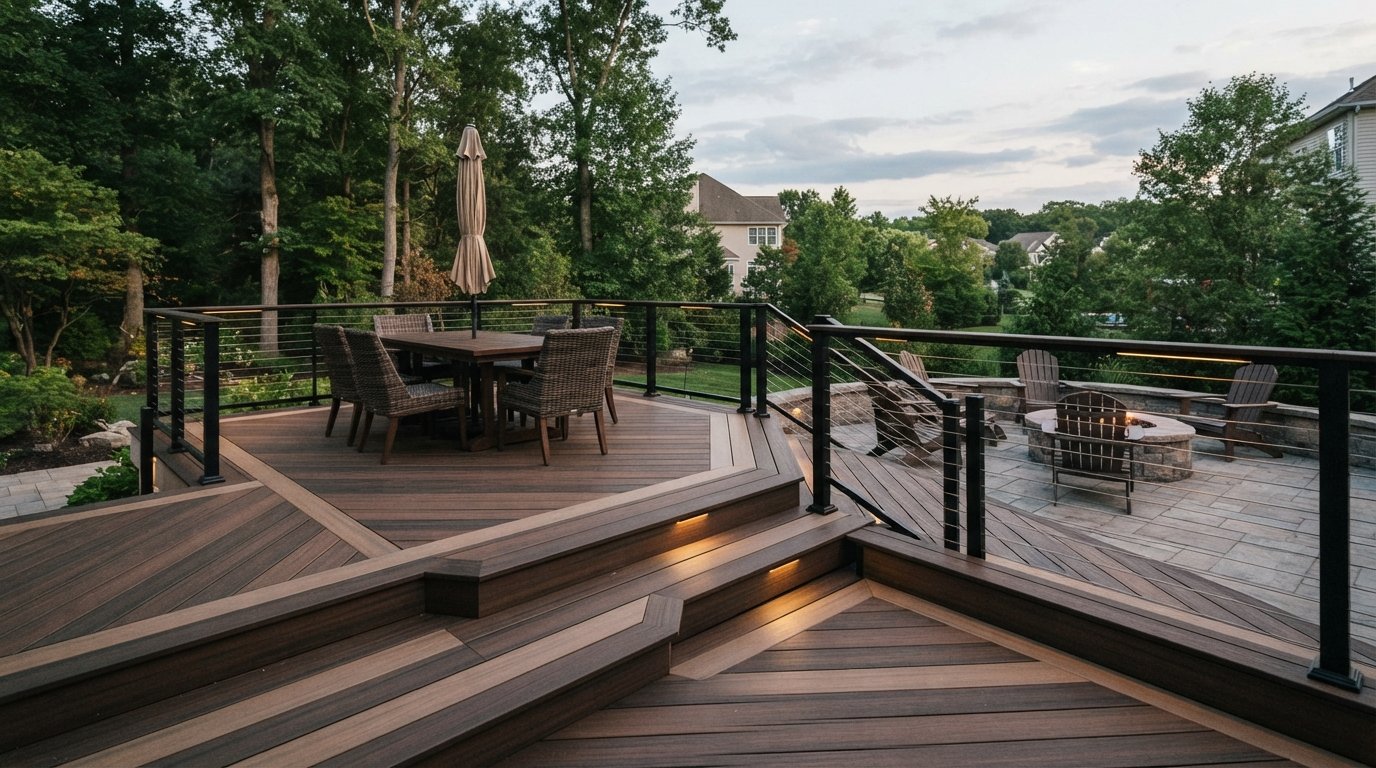
For clay-heavy soils that shift during freeze-thaw cycles, builders may install deeper footings or helical piles to preserve level and stability.
Moisture-resistant composites, well-ventilated substructures, and sealed fasteners are prioritized to reduce moisture damage and prolong appearance and performance.
Hiring a local deck specialist is commonly recommended to protect your investment because local experience informs site-specific choices and code compliance.
In coastal areas, builders require stainless steel screws and fasteners to prevent rust and salt-air corrosion.
Design features and engineered materials target the Mid-Atlantic mix of humid summers and freeze-thaw cycles to reduce deterioration of wood and metal components.
What maintenance practices are recommended for decks to maintain durability throughout all seasons in NJ?
Regular inspections and material-appropriate care preserve deck durability across New Jersey’s seasons.
Homeowners should inspect their decks at least twice a year, ideally in spring and fall, to check for fastener corrosion, framing issues, or decking damage.
With proper maintenance, wood decks typically last 10–20 years in New Jersey while composite decks can last 25–30 years or more according to local sources.
Composite materials require relatively low maintenance to preserve a like-new look for years, per local contractor guidance.
Pressure-treated wood requires annual sealing or staining and has an expected lifespan of roughly 10–20 years when maintained.
Capped composite specifically is noted for low maintenance and a long service life in the ledger, reducing the frequency of major upkeep.
What warranty or guarantees do NJ deck builders offer for four-season durability?
The ledger does not provide specific, standard warranty terms or guarantee language from New Jersey deck builders, so the common warranty packages offered are unknown from the provided sources.
Because the sources do not list standard warranty lengths or coverage, you should ask any prospective contractor for written warranty details and confirm coverage for materials, workmanship, and seasonal issues before signing a contract.
Why consider a local, licensed contractor for four-season deck projects (and a call to action)?
Choosing a local, licensed contractor matters because township permit rules, frost-line requirements, and local building-code amendments affect how durable decks are designed and approved.
Local builders commonly handle the permit process and coordinate inspections — footing, framing, and final — with municipal authorities to keep projects code-compliant.
Site-specific engineering of footings below the freeze line is a frequent requirement to prevent frost heave, and many builders explicitly engineer footings to local conditions.
Local contractors tailor material selection and fastening strategies for the New Jersey climate, prioritizing moisture-resistant composites, ventilated substructures, and corrosion-resistant fasteners in coastal areas.
Finding a local deck specialist is widely recommended to protect your investment because local expertise aligns design with the climate, soils, and codes that determine long-term performance.
The claim ledger does not include the specific business details (license number, contact info, or service-area marketing copy) for Isaac and Son Construction provided in the campaign context, so those particulars are unknown from the cited sources and should be verified directly with the company.
kitchen remodeling contractor in NJ
| Brand/Type | Freeze-Thaw Durability | Notes |
|---|---|---|
| Trex composite | Exceptional (No cracking or expansion damage) | Impervious to rot, moisture, termite damage; avoids regular staining |
| TimberTech AZEK PVC | Maximum (100% moisture-impervious) | PVC decking performs better in wet environments common in coastal NJ, excellent |
| Composite decking (general) Durable Deck Materials For Pennsylvania Weather | Built for four-season climates and tested in harsh conditions including snow and Durable Deck Materials For Pennsylvania Weather | Excellent moisture resistance, strong performance during freeze-thaw cycles, low |
| Material | Durability / Moisture Resistance (ledger) | Typical Lifespan (ledger) | Maintenance |
|---|---|---|---|
| Capped Composite | Excellent (moisture-resistant, freeze-thaw tested) | 25–50 years | Low maintenance |
| PVC (TimberTech/AZEK) | Maximum moisture-impervious; excels in wet/coastal areas | Not specified in ledger | Very low maintenance |
| Pressure-Treated Wood | Prone to warping and moisture issues without sealing | 10–20 years | Requires annual sealing/staining |
| Exotic Hardwood (Ipe) | High natural durability; premium maintenance needs | Not specified in ledger | Maintenance required to preserve appearance |
Key Takeaways
- Choose capped composite or PVC in wet/coastal areas for the best moisture and freeze-thaw performance.
- Always place footings below the local frost line (commonly 36–42 inches cited) and confirm footing design with code before excavation.
- Inspect your deck at least twice a year (spring and fall) and repair or replace degraded framing before installing new decking.
Frequently Asked Questions
What is the/4/5 rule for decks?
The claim ledger does not contain a description of the/4/5 rule for decks, so its definition is unknown from the provided sources.
What is the longest lasting deck material?
Capped composite decking is described in the ledger as the longest-lasting common deck material, with a listed lifespan of 25–50 years.
What are the building code guidelines for decks in New Jersey?
New Jersey follows the International Residential Code with local amendments for decks, and footings must be below the local frost line with municipal permits and zoning often required before building.
Is there anything better than Trex?
The ledger shows Trex composite is marketed as maintenance-free and impervious to rot and moisture, while some PVC products (TimberTech AZEK) are described as 100% moisture-impervious and perform especially well in wet coastal areas.
Sources
- 2025 Deck Building Code Updates (2025-04-28)
- Durable Deck Materials For Pennsylvania Weather (2025-09-02)