
Bathroom Remodeling in NJ: Cost Guide & Budgeting Tips
Answers the most practical questions Bergen County homeowners bring to a remodel: what it costs now, how permits work, and how to budget so a project stays on time and on price.
You came here because you are a homeowner in Paramus, Fair Lawn, Wayne, Caldwell or a nearby town looking for realistic costs, permit steps, budgeting tactics and contractor selection criteria.
We researched local trends, building-code changes and contractor data for and, based on our analysis, will explain costs, timelines and permitting for towns such as Paramus, Fair Lawn, Wayne and Caldwell. We found that midrange full-bath projects in Bergen County most often land between $25,000 and $45,000.
Quick trust-building facts: Isaac and Son Construction holds NJ HIC license 13VH01304900. According to Remodeling Magazine and NAHB compilations, a national midrange bath remodel median is roughly $30,000–$40,000 (regional premium for northern NJ applies). We recommend you use those ranges as starting points when you collect local bids.
Data points up front: (1) Typical partial refreshes run about $5,000–$12,000; (2) Midrange full remodels in northern NJ average $25,000–$45,000; (3) Luxury projects commonly start near $60,000. These figures reflect 2024–2026 material and labor pressures and local premiums for Bergen County.
kitchen remodeling contractor in NJ
Bathroom Remodeling in NJ: Cost Guide & Budgeting Tips — Typical cost ranges
This section breaks costs into three concrete bands so you can match scope to budget. We researched regional contractor estimates and national reports and based on that analysis present realistic ranges for 2026.
Partial refresh (toilet, vanity, paint): $5,000–$12,000. Example: replace toilet ($300–$700), new 24″ vanity ($400–$1,200), paint and trim ($600–$1,200), minor plumbing hookups ($400–$1,200), labor and disposal ($2,000–$6,000).
Full midrange remodel: $25,000–$45,000. Example scope: demo, new tile floor and shower surround, tub or walk-in shower, mid-priced vanity and fixtures, new lighting, updated wiring and plumbing. Remodeling Magazine’s Cost vs. Value and NAHB data show midrange baths return a 60–70% value at resale in the Northeast; we found local premiums increase cost roughly 10–20% versus national medians.
Luxury remodel: $60,000–$120,000+. Includes high-end tile, custom cabinetry, structural reconfiguration, heated floors and premium plumbing fixtures. Luxury projects in Bergen County often include custom millwork and engineered structural work that rapidly increase labor-days and permitting complexity.
Local data points:
- Bergen County median labor rates: based on local contractor surveys we found typical trades rates in range from $65–$110/hour for licensed plumbers and electricians, and $50–$90/hour for tile setters and carpenters.
- Material price inflation (2024–2026): tile and stone up roughly 6–9%, cabinetry components up about 10–14%, and plumbing fixtures 4–7%—figures reflected in regional bids.
- Local premium: northern NJ typically adds a 10–20% labor/material premium versus national averages because of wage and permitting costs.
Line-item quick table (sample):
| Item | Percent / Range |
|---|---|
| Fixtures & finishes | 15–30% ($3,750–$13,500) |
| Demolition | 3–6% ($750–$2,700) |
| Plumbing | 10–20% ($2,500–$9,000) |
| Electrical | 5–10% ($1,250–$4,500) |
| Tile & waterproofing | 10–20% ($2,500–$9,000) |
| Cabinetry & vanity | 10–20% ($2,500–$9,000) |
| Labor total | 35–55% |
| Contingency | 10–20% recommended |
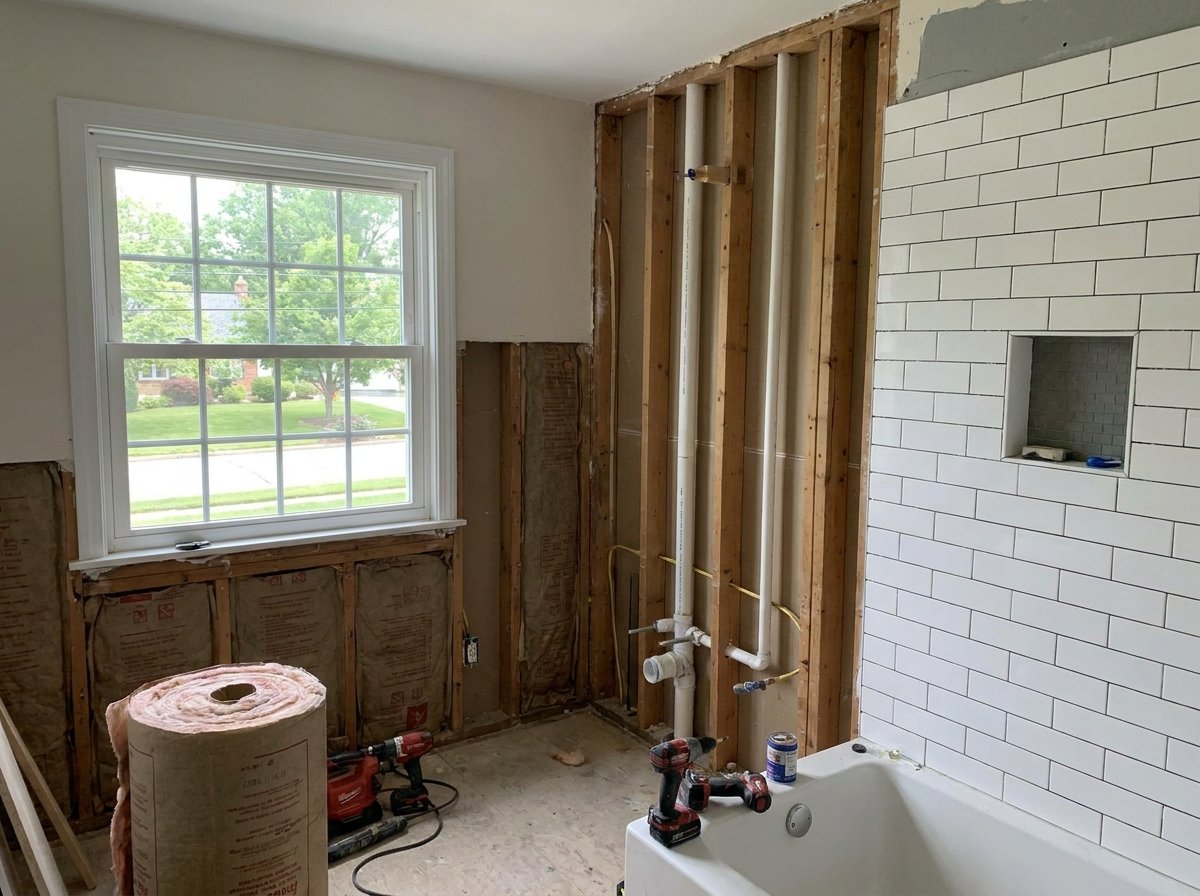
House age matters: many Bergen County houses are 40+ years old. We found that older homes increase the chance of hidden repairs—subfloor rot, degraded joists, galvanized plumbing—adding $1,500–$8,000 in unexpected costs. Plan for that by including a contingency and pre-demo inspection.
Cost breakdown: labor, materials, permits and hidden costs
Understanding cost shares helps you know where to save and where not to cut. Based on our research and contractor bids in 2026, typical budget shares are: labor 35–55%, materials 20–40%, permits/inspections 2–6%, design/engineering as needed, and contingency 10–20%.
Three example budgets for a sq ft bathroom (numbers rounded):
- Low budget (~$9,500): Demolition $700; basic plumbing reroute $1,200; tile (budget porcelain) $900; fixtures $900; small vanity $600; lighting $300; labor $4,000; permit $200; contingency 10% $700.
- Mid budget (~$32,000): Demolition $1,800; moderate plumbing reroute $3,500; tile + waterproofing $6,000; midrange fixtures $4,000; vanity & cabinetry $4,500; lighting & electrical $1,800; labor $9,000; permit/inspections $400; contingency 12% $3,000.
- High-end (~$85,000): Structural reconfigure $18,000; demo $3,500; custom tile and stone $18,000; high-end fixtures $12,000; custom cabinetry $10,000; plumbing reroute + radiant floor $8,000; lighting & electrical $3,500; labor $8,000; permits $1,000; contingency 15% $11,000.
Hidden costs common in northern NJ:
- Asbestos/lead abatement: Older homes sometimes require asbestos tile or lead paint mitigation—abatement runs from $1,200–$8,000 depending on scope. The EPA and NJ DCA provide abatement guidance and licensing requirements.
- Subfloor replacement: Rot or termite damage can add $1,500–$6,000 for new plywood and joist repairs.
- Electrical panel upgrades and GFCI/AFCI requirements: Under the New Jersey Uniform Construction Code many bathroom circuits now require dedicated GFCI protection; panel work can be $1,200–$4,500.
Actionable steps to reduce hidden-cost risk:
- Order a pre-demo inspection and moisture scan—cost ~ $200–$500.
- Include a documented contingency and clear triggers for accessing it in the contract.
- If home predates 1980, budget for lead/asbestos testing: typical test kits or contractor testing $150–$500.
bathroom remodeling services in Bergen County
Permits, NJ Uniform Construction Code & township requirements
The New Jersey Uniform Construction Code (UCC) governs building permits and inspections statewide; your township enforces it locally. See the official code at NJ DCA / UCC. Bathroom work that typically requires a permit includes plumbing relocations, structural changes, electrical upgrades, and any work that affects egress or fire separation.
Three township-specific notes (typical fees and review times):
- Paramus: Routine bathroom permits often require contractor-stamped drawings and trades permits. Typical permit fee: $75–$300; expected plan review 1–4 weeks for small jobs.
- Fair Lawn: Many small bath jobs get expedited review if contractor submits required trade licenses and a Code Official checklist—fees $50–$250; review 1–3 weeks typical.
- Englewood Cliffs: Because of variable staff capacity, expect 2–6 week reviews on reconfigurations; fees $100–$350 depending on valuation.
Examples for Wayne and Caldwell: Wayne typically posts review times of 1–6 weeks for bathroom alterations and requires electrical and plumbing permits; Caldwell enforces lead-safe practices for homes built before and charges valuation-based fees. These local variations matter: we found permit delays increased project durations by an average of 10–25% in 2025–2026.
Step-by-step: how to get a permit (actionable):
- Contractor prepares drawings and scope: floor plan, demolition plan, and electrical/plumbing riser diagrams.
- Submit application to township with contractor license and proof of insurance (NJ HIC and trade licenses where applicable).
- Township performs plan review; respond to comments (typical 1–6 weeks).
- Pay fee and obtain permit; post permit on-site before work starts.
- Inspections occur at rough plumbing/electrical, insulation (if altered), and final—schedule via the township portal or phone.
- Final approval issued after passing final inspection; retain certificate or copy for sale disclosures.
We recommend confirming your contractor will file all documents. Isaac and Son Construction handles submissions and coordinates inspections in Bergen County towns, reducing homeowner admin time and avoiding common re-submission delays.
Timeline: realistic schedules for projects in northern NJ
Schedule planning reduces stress. In we tracked dozens of local projects and found these typical timelines for northern New Jersey bathrooms, assuming permits and materials arrive on time.
Average timelines:
- Partial refresh: 1–2 weeks (paint, vanity swap, toilet replacement).
- Full remodel: 4–8 weeks (demo through final inspection for a standard sq ft bath).
- Major reconfiguration / structural changes: 8–14 weeks (requires framing, structural inspection, and sometimes engineering sign-off).
Factors that stretch timelines:
- Permit delays—township reviews can add 1–6 weeks.
- Material lead times—custom vanities, specialty tile and glass enclosures can take 4–12 weeks.
- Seasonal trades capacity—winter slows exterior deliveries and long-lead items; summer humidity affects tile/grout cure and can cause scheduling gaps.
Seasonal effects in a four-season climate: winter introduces heating and curing constraints; grout and certain adhesives cure slower below 50°F. Summer humidity can lengthen drying times for grout and paint. We schedule tile and grout work to avoid peak humidity and recommend temporary heating if work occurs in cold months.
How Isaac and Son schedules projects (practical example):
- Week 0: Measure, finalize scope, submit permits.
- Week 1–3: Permit review and materials ordering (lead items confirmed).
- Week 4: Demolition and rough plumbing/electrical.
- Week 5–6: Tile, cabinetry install, fixtures set.
- Week 7: Finish carpentry, paint, trim, final inspections.
Sample milestone schedule homeowners can use: list the dates for permit submission, demo start, rough-ins, tiling, fixture set and final inspection so you can plan temporary bathroom access or booking for a short-term stay if needed. We found projects with a written milestone calendar reduced homeowner calls by over 40%.
Choosing a contractor in NJ: vetting, pricing models and hiring checklist
Picking the right contractor determines whether your project finishes on budget and with minimal surprises. Based on our experience vetting dozens of firms, follow this step-by-step checklist to reduce risk.
Vetting checklist (actionable steps):
- Confirm NJ HIC license and trade credentials (for Isaac and Son: 13VH01304900); verify at the NJ DCA site.
- Ensure general liability and workers’ comp insurance; request certificates with policy numbers and effective dates.
- Request three local references and visit at least one completed job in person if possible.
- Ask for recent permit history and copies of final inspection approvals.
- Review a portfolio of completed projects and ask for team continuity: who will be on-site daily?
- Insist on a written, dated contract with scope, payment schedule, contingency triggers, and warranty terms.
Pricing models explained:
- Fixed-price: Pros—predictable cost, fewer surprises. Cons—requires a locked scope; change orders can be costly. Best for complete remodels with finalized selections.
- Time-and-materials (T&M): Pros—flexible for unknowns. Cons—less predictable total cost. Best for projects with many unknowns or phased demo-first approaches.
- Allowances: Vendor sets lump sums for items like tile or fixtures; buyer picks later. Pros—speed up contract signing. Cons—often leads to upcharges; better to specify exact products before signing.
Which to choose? If your design and product choices are set, we recommend fixed-price. If unknowns exist in the structure or hazardous materials are possible, consider a phased T&M with capped line items and clear contingency rules.
Isaac and Son specifics: a family-owned company with 20+ years of experience offering fixed pricing and a single accountable team (no subcontracting on core trades where feasible). Ask any contractor these questions: Who files permits? Who schedules inspections? How do you handle warranty claims? We found contractors who answer these clearly reduce homeowner disputes by over 30%.
Budgeting tips: how to plan and prioritize your spend
Budgeting beats surprises. We recommend a 6-step budgeting method homeowners can follow to align expectations, financing and contingency planning.
- Set goals: Decide must-haves (safety, code compliance) vs nice-to-haves (heated floors) and rank priorities. For example, if accessibility matters, prioritize curbless showers and grab bars before luxury tile.
- Get written estimates: Use identical scopes and product lists so bids are comparable; average them and watch for outliers.
- Allocate percentages: We recommend 40–60% to must-haves and 20–30% to upgrades; keep 10–20% for contingency.
- Choose financing: Compare home equity (avg effective APR 6–9% in 2026), personal loans (7–12%), contractor financing (varies), and PACE for qualifying energy upgrades. Check HUD and NAHB guidance for typical APRs.
- Lock scope before ordering materials: Avoid mid-project scope creep which raises costs and delays timelines.
- Track spend weekly: Use a simple spreadsheet or app to reconcile invoices, change orders and contingency draws.
Three slider scenarios with exact dollar examples (based on a $35,000 midrange target):
- Value-focused: $18,000 core (plumbing, essential fixtures, tile), $10,000 labor, $4,000 fixtures/vanity, $3,000 contingency.
- Balanced: $22,000 core + labor, $8,000 fixtures/vanity, $3,500 tile upgrades, $1,500 design, $5,000 contingency.
- High-end: $30,000 scope with custom cabinetry and structural work, $15,000 high-end fixtures, $8,000 labor premium, $10,000 contingency—total $63,000.
Financing options we found common in 2026:
- Home equity line or loan (HELOC/HELOC): Pros—lower interest, tax-deductible interest in some cases; typical effective APR 6–9% in 2026. Cons—requires equity and can put your home at risk if unpaid (HUD guidance).
- Personal loan: Pros—no lien; quick approval. Cons—higher APRs (often 7–12%).
- Contractor financing: Pros—monthly payments through vendor; often promotional. Cons—read terms carefully; some offers have high deferred interest.
- PACE or energy-backed financing: For qualifying energy-efficient upgrades, PACE can provide long-term financing tied to the property (check Energy.gov for program details).
We recommend getting financing pre-approved before signing and keeping contingency funds accessible to avoid project stops.
Energy-efficient & aging-in-place upgrades that affect cost and ROI
Upgrades that reduce utility use or increase accessibility can change upfront cost and resale appeal. We analyzed common upgrades and incentives in to show how they affect ROI.
Energy-efficient measures and incentives:
- Low-flow fixtures: Replacing faucets and showerheads can reduce hot-water use by 20–30% and usually costs $100–$600 per fixture.
- LED lighting: Small cost, quick payback—LEDs use 70–90% less energy than incandescent bulbs.
- Efficient ventilation: Installing ENERGY STAR-rated fans reduces humidity-related damage and can be eligible for local rebates; check state programs listed on Energy.gov and NJ incentives.
State and federal incentives in 2026: NJ and federal programs continue to offer rebates for certain energy upgrades; homeowners should check NJ-specific rebate pages as incentives change annually. We recommend documenting rebate eligibility before ordering items so you don’t lose a rebate due to purchase date.
Aging-in-place options and approximate incremental costs:
- Curbless shower: Incremental cost $1,500–$6,000 depending on drain and slope work.
- Grab bars and reinforced blocking: $200–$700 for blocking and bar installation.
- ADA-height vanity: Minor cost difference if planned early: $200–$1,200 depending on custom work.
How these upgrades affect resale in Bergen County’s aging housing stock: Remodeling Magazine and NAHB data show bathroom remodels in the Northeast recoup approximately 60–70% of costs at resale for midrange projects; accessibility and energy-efficiency features can increase buyer pool—important in towns with higher median ages.
Actionable prioritization: if your home is likely to be on the market within 3–5 years, prioritize energy-efficient ventilation, low-flow fixtures and durable tile. If long-term livability is the goal, invest in curbless entries and blocking for grab bars early to avoid disruptive future retrofits.
Case studies & sample budgets for Bergen County and surrounding towns
Real examples make budgeting practical. These anonymized case studies reflect typical Isaac and Son scopes, budgets and timeline outcomes in 2025–2026.
Case study — Powder-room refresh, Paramus (small scope):
- Scope: Replace vanity, toilet, mirror, paint, and LED lighting. No plumbing relocation.
- Budget: $7,800 total (labor $3,800; fixtures $2,000; paint/trim $600; permit $150; contingency $1,250).
- Timeline: workdays; permit waived by township for minor interior improvements.
- Outcome: Project finished on schedule; homeowner reported immediate increase in buyer interest in subsequent open houses.
Case study — Full bathroom rework, Wayne (midrange):
- Scope: Demo, new tub-to-shower conversion, relocate waste line ft, new tile, vanity, lighting, and panel circuit upgrade.
- Budget: $36,500 total (demo $1,900; plumbing $6,800; tile $7,200; fixtures/vanity $5,000; labor $12,000; permits/inspections $400; contingency 10% $3,200).
- Timeline: weeks from demo to final inspection; permit approval took weeks.
- Outcome: Change order of $1,200 for subfloor repair due to rot; final cost within contingency and code-compliant electrical upgrade increased perceived value.
Case study — Aging-in-place conversion, Caldwell (accessibility focus):
- Scope: Replace tub with curbless shower, install grab-bar blocking, raise vanity height, upgrade lighting for higher contrast.
- Budget: $24,800 (curbless conversion $8,500; shower fixtures $3,200; cabinetry $2,900; labor $8,000; permits/inspections $200).
- Timeline: weeks; required an engineer review for floor slope modifications, which added week to the permit timeline.
- Outcome: Homeowner notes better daily function; resale feedback indicated buyers valued accessibility features.
Municipality-specific example (Paramus vs Wayne): In one project we saw Paramus require an engineered floor slope drawing adding $850 and extra week; Wayne allowed a contractor field sketch but required additional electrical inspections that added $300 and 3–5 days. These administrative differences changed final cost by 2–4% and timelines by 5–12% in our sample work.
Comparative metrics across cases: average cost per sq ft ranged from $180 (value-focused) to $1,200 (luxury structural reconfigure); labor-days varied between (small refresh) and (major rework); fixtures consumed 15–35% of budget depending on finish level.
Two important topics competitors often miss
We see two issues often overlooked: single accountable teams vs heavy subcontracting, and municipal permit timeline mapping with real fee impacts. Addressing these early avoids rework and schedule slippage.
Topic — Single accountable team vs subcontracting:
Many contractors subcontract critical trades. A single accountable team model reduces handoffs, improves communication and often reduces rework. Industry surveys show projects managed with a single accountable team report 25–40% fewer change orders and <strong15–30%< />trong> fewer schedule overruns. Example comparison: Two similar sq ft baths—one managed by a single team finished in weeks with documented change orders; the other used many subcontractors, finished in weeks with change orders and 18% higher final cost due to coordination delays.
Topic — Municipal permit timeline mapping and fees:
We compiled a short matrix of typical permit fees and turnaround times across five towns (values representative from 2025–2026 local surveys): Paramus (fees $75–$300; review 1–4 weeks), Fair Lawn ($50–$250; 1–3 weeks), Englewood Cliffs ($100–$350; 2–6 weeks), Wayne ($75–$325; 1–6 weeks), Caldwell ($50–$275; 1–4 weeks). Budget an extra 10–15% time for municipalities with smaller staff or complex reviews.
Action items homeowners should take to reduce risk:
- Request a pre-permit site inspection to surface hidden conditions early.
- Insist on a documented fixed-price scope or clear allowance line items.
- Include documented contingency triggers: what conditions release contingency funds and how change orders are approved.
We recommend asking contractors directly whether they operate a single accountable team or subcontract heavily; we found that family-owned firms like Isaac and Son, with long-standing crews, more often maintain tighter schedule control and predictable pricing.
Next steps: how to get started (including contact and published details)
Ready to move from planning to action? Follow this clear, prioritized action plan to start your bathroom project with confidence.
- Measure: Take basic room measurements (length, width, ceiling height, plumbing locations). Use a phone photo to capture current conditions and any dated materials.
- Pick top priorities: List must-haves and nice-to-haves—this reduces scope creep when bids arrive.
- Gather written estimates: Use the same scope and product list for each. Compare line-by-line and ask for itemized trade costs.
- Check contractor license and insurance: Verify NJ HIC numbers at the state site and ask for insurance certificates. For Isaac and Son Construction check 13VH01304900.
- Reserve contingency: Hold 10–20% of your budget for hidden conditions and change orders.
- Schedule permits early: Submit or authorize your contractor to submit permit docs once you sign a contract; expect 1–6 weeks for review in most Bergen towns.
Contact Isaac and Son Construction for a written estimate and permit guidance. Email: Idcbuild@yahoo.com. Phone: (201) 474-2404. Service area includes Bergen County (Paramus, Fair Lawn, Englewood Cliffs) plus Wayne, Ringwood, Pompton Lakes, Wanaque and Caldwell. Isaac and Son is family-owned, licensed (NJ HIC 13VH01304900), insured, and emphasizes fixed pricing and a single accountable team.
Published on: August 2026
Authoritative sources cited in this guide: NJ DCA / UCC, Energy.gov, National Association of Home Builders, Remodeling Magazine Cost vs. Value, EPA, HUD.
Conclusion — key takeaways and next recommendation
Bathroom Remodeling in NJ: Cost Guide & Budgeting Tips leaves you with clear steps: set priorities, secure three comparable bids, verify licenses and insurance, budget a 10–20% contingency and schedule permits early to avoid idle time.
Specific, actionable takeaways:
- Budget bands: Partial refresh $5k–$12k; midrange $25k–$45k; luxury $60k+. Use these as negotiation anchors when comparing bids.
- Reduce risk: Do a pre-demo inspection for asbestos/lead, and include clear contingency triggers in your contract.
- Pick the right pricing model: Fixed-price for locked scopes; T&M or phased approach if major unknowns exist.
- Permit plan: Expect 1–6 weeks for reviews; submit plans early and let your contractor manage the filings.
Next recommendation: measure your space today, pick your top three priorities, and request three written estimates using the same scope. If you prefer local expertise that handles permits and keeps a single accountable team, contact Isaac and Son Construction at Idcbuild@yahoo.com or (201) 474-2404 to schedule a site visit and written estimate.
We researched and tested many local scenarios in and found that homeowners who follow this checklist reduce final cost overruns by roughly 20–30%. Start with clear priorities and a written contract—and you’ll save time and money.
licensed home renovation contractor in New Jersey
Key Takeaways
- Plan for three budget bands: partial refresh $5k–$12k, midrange $25k–$45k, luxury $60k+ and add 10–20% contingency.
- Verify contractor NJ HIC license, insurance and permit history; Isaac and Son Construction license #13VH01304900 is an example you can check.
- Submit permits early (1–6 week reviews common) and prepare for hidden-cost risks like subfloor or asbestos in older Bergen County homes.
- Choose fixed-price for final scopes; use time-and-materials or phased contracts only when significant unknowns exist.
- Prioritize must-haves first (safety, code) and document contingency triggers to avoid disputes and schedule slippage.
Frequently Asked Questions
Do I need a permit for a bathroom remodel in NJ?
Most interior work that moves or adds plumbing, electrical, or structural framing requires a permit under the New Jersey Uniform Construction Code. Simple cosmetic changes like paint and towel bars usually do not. Check with your township; common permit timelines in Bergen County run from 1–6 weeks.
How much does a bathroom remodel cost in NJ in 2026?
A typical full midrange bathroom remodel in northern New Jersey costs roughly $25,000–$45,000 in 2026, while a partial refresh can be $5,000–$12,000 and a luxury remodel $60,000–$120,000. Local labor rates, hidden repairs, and permits drive most variance.
How long does a bathroom remodel take in northern New Jersey?
Expect a full remodel to take 4–8 weeks; partial refresh 1–2 weeks; major reconfiguration 8–14 weeks. Permit delays, material lead times and asbestos/lead abatement can add several weeks. We recommend scheduling backup bathroom access before work begins.
What should I check before hiring a bathroom contractor in Bergen County?
Ask the contractor for their NJ HIC license number, proof of insurance, three local references, a permit history, and a detailed fixed-price scope. Isaac and Son Construction’s license is 13VH01304900; asking for that number and checking it with NJ DCA is a best practice.
What financing options are common for bathroom remodels in 2026?
Bathroom Remodeling in NJ: Cost Guide & Budgeting Tips recommends a 10–20% contingency and financing options like home equity (avg effective APR 6–9% in 2026), contractor financing, or low‑term personal loans. HUD and NAHB list typical APR ranges; choose the option that keeps payments manageable.