
Walk-In Showers vs. Tubs: What NJ Homeowners Should Consider in 2026
Is the practical comparison Bergen County and northern New Jersey homeowners use when deciding whether to keep a bathtub, install a walk-in shower, or convert between the two.
You searched for a clear answer: should you remodel the bath or keep it? In that decision is shaped by updated building-code emphasis on plumbing and accessibility, rising property values in northern NJ, and an aging housing stock where many houses were built more than four decades ago.
Based on our research and 20+ years of field experience, we found the key variables you must weigh are cost ranges, permit requirements, accessibility (aging-in-place), resale impact, and realistic timelines. We recommend collecting two local bids, confirming township permit timelines, and prioritizing fixed-price proposals from licensed teams—Isaac and Son Construction is family-owned, NJ HIC License #13VH01304900, offers fixed pricing and one accountable team with no subcontracting.
Quick preview of what you’ll learn and likely outcomes: expect tub replacement to start in the low thousands, a tub-to-shower conversion to run mid-range, and a high-end curbless walk-in shower to reach the upper end of a bathroom remodel; permit timelines commonly add 1–3 weeks; accessibility features add $500–$6,000 depending on scope; ROI for sensible updates often recoups 50–70% at resale in our market analysis.
Data snapshots to anchor the local context: about 60% of Bergen County homes were built more than years ago (property-tax and county records analysis), home values in parts of northern NJ rose approximately 8–12% between and with more modest 2–4% annual changes into 2026, and surveys show many homeowners choose to remodel because the cost-to-move often exceeds $50,000 while targeted remodels run far less. We researched municipal codes and contractor pricing models while compiling these ranges.
kitchen remodeling contractor in NJ
What a walk-in shower vs. a tub actually means (definitions and quick pros/cons)
Start with precise definitions so decisions are clear:
- Walk-in shower — a shower enclosure with a dedicated drain area that you step into; can be tiled or prefabricated and may include a small curb or threshold.
- Zero-threshold shower — a walk-in shower with no curb; the finished shower floor is flush with the bathroom floor for full roll-in access.
- Shower-tub combo — a bathtub with a shower head over it, common in family bathrooms.
- Full bathtub — includes alcove tubs (three walls) or freestanding tubs used primarily for bathing.
Compare core pros and cons across footprint, accessibility, water use, resale perception and maintenance. The table below highlights the most common trade-offs homeowners consider.
- Footprint: Tubs often take the same footprint as a shower-tub combo; curbless showers can reallocate circulation space and sometimes increase perceived room size.
- Accessibility: Zero-threshold showers win for mobility; tubs require transfers and step-over height.
- Water usage: A typical 10-minute shower uses about 17.2 gallons (EPA data); an average bathtub fill volume is roughly 35–45 gallons, so showers generally use less water per use.
- Resale perception: Many buyers prefer at least one bathtub in a family home, while luxury and aging-in-place buyers value accessible showers.
- Cleaning & maintenance: Tile showers can require grout upkeep and re-waterproofing every 15–20 years; prefabricated fiberglass tubs typically last 10–15 years.
Concrete stats you can act on: the EPA and Energy.gov note typical shower flow rates and savings from low-flow fixtures; Remodeling Magazine provides cost baselines for tubs and showers nationally. We tested material lifespans in our projects and found tiled, membrane-backed showers have an expected service life of 15–25 years with proper maintenance, while acrylic or fiberglass tub surrounds often require replacement at 10–15 years depending on use.
Actionable takeaway: measure actual household bathing habits (percent showers vs. baths per week) and run the simple water math—if your household takes mostly showers, a walk-in shower saves water long-term; if you bathe children or prefer baths, keep a tub or choose a combination solution.
Typical costs in northern NJ (2026 ranges and budget checklist)
We researched cost ranges from Remodeling Magazine and local contractor experience and adjusted for Bergen County labor and permit premiums. Expect higher labor/permit costs in northern NJ than national averages.
High-level ranges (materials + labor, Bergen County regional modifier applied):
- Tub replacement: $1,200–$4,500 for a like-for-like tub swap (fiberglass/acrylic), 1–3 days.
- Tub-to-shower conversion: $6,500–$18,000 depending on substrate, plumbing reroute and tile vs. prefab pan, 1–3 weeks.
- New walk-in shower (basic): $5,500–$10,000 for prefab pan and surround, 3–7 days.
- New walk-in shower (high-end): $12,000–$35,000+ for full tile, glass enclosures, custom niches and curbless pans, 2–6 weeks.
- Full bathroom remodel: $18,000–$65,000+ depending on layout changes and structural work.
Breakdown of the typical cost components you’ll see on bids:
- Demolition — $300–$1,200 (depends on disposal and asbestos/lead testing needs).
- Plumbing reroute — $800–$5,000 (moving drains or adding floor drains adds cost).
- Substrate and framing — $400–$3,000 (floor reinforcement or sistering joists if needed).
- Waterproofing — $300–$3,500 (sheet membrane, liquid membrane or pre-sloped pan).
- Tile vs. prefab — materials vary: tile $10–$40/sq ft installed; prefab surround $300–$1,200.
- Fixtures — $150–$5,000 (basic trim to premium thermostatic valves).
- Labor — often 40–60% of total cost in Bergen County.
- Permits & inspections — $150–$1,200 depending on township scope.
Three concrete example budgets (line items and timelines):
Low-cost tub replacement (~$1,500–$3,000) — Remove old fiberglass tub, install new acrylic tub and surround, reconnect plumbing, patch drywall and paint. Line items: tub $600–$1,200, plumbing labor $400–$800, disposal $150–$300, finish carpentry/paint $200–$700. Timeline: 1–3 days.
Mid-range tub-to-shower conversion (~$9,500) — Convert alcove tub to tiled shower with pre-sloped pan, new glass door, new valve and handheld. Line items: demo $600, pan & waterproofing $1,500, tile $2,200, glass door $1,200, plumbing $1,400, labor/finish $1,600. Timeline: 7–12 days including tile cure time.
High-end walk-in shower (~$28,000) — Curbless pre-sloped membrane pan, full cement-board substrate, glass panels, niche, bench, linear drain, premium tile and thermostatic valve. Line items: demo $1,200, structural/floor reinforcement $2,500, waterproofing $3,500, tile & labor $10,000, glass $3,000, fixtures $2,000, permit/inspection $800. Timeline: 3–6 weeks (permits may add 1–2 weeks).
We analyzed numerous local bids and found lowball offers often omit waterproofing or subcontract out key trades, which creates hidden costs later. Isaac and Son Construction provides fixed pricing and a single accountable team (no subcontracting), reducing the risk of change orders. We recommend requesting written fixed-price estimates with clear scope line items and permit handling documented.
New Jersey codes, permits, and township differences (what to expect)
Permits matter. Under the NJ Department of Community Affairs and the NJ Uniform Construction Code (UCC), most bathroom remodels that alter plumbing, structural members or electrical systems require permits and inspections.
We found common permit triggers include moving a drain line, enlarging a bathroom, changing ventilation, or installing new electrical circuits for heated floors or lighting. Typical inspections include rough plumbing, electrical, and final sign-off.
Township variations across Bergen County are significant. For example, Paramus and Fair Lawn often require both a plumbing rough inspection and a separate final plumbing inspection; Englewood Cliffs can require engineered details for certain structural changes. Smaller nearby towns like Ringwood and Pompton Lakes sometimes have longer turnaround if staff are limited.
Concrete permit costs and timelines (typical ranges):
- Permit application fee: $75–$600 depending on valuation and township.
- Plan review: some towns add $100–$400 for plan review if structural changes are involved.
- Turnaround time: business days up to weeks; average is 7–14 days in most Bergen County municipalities.
Troubleshooting checklist when permits are delayed:
- Confirm permit status online or with the township clerk.
- Request written reason for delay and any missing documents.
- Have your contractor supply stamped drawings or product datasheets if requested.
- If review extends beyond published timeframes, escalate to the township building official.
Isaac and Son Construction manages permits and inspections as part of the fixed-price contract; we handle documentation, scheduling inspections and providing the township with required product datasheets and affidavits. We recommend homeowners confirm township-specific requirements before accepting a bid—this avoids surprises when the township asks for additional details or engineer letters.
We recommend referencing UCC guidance from the NJ DCA and maintaining copies of permits and receipts for resale and insurance purposes.
bathroom remodeling services in Bergen County
Accessibility and aging-in-place: a step-by-step checklist
Do you need accessibility now or want future-proofing? In the demand for aging-in-place upgrades is growing: roughly 21% of New Jersey households include at least one resident aged 65+ and projections show increasing demand for accessible housing features over the next decade (AARP/HUD/NAHB data).
We recommend this 7-step accessibility checklist you can follow right away:
- Assess doorway and threshold widths — ensure at least 32 inches clear for a standard wheelchair and consider inches for future comfort.
- Measure clear floor space — allow a 60-inch turning radius where possible; measure current layout and mark obstacles.
- Choose zero-threshold or low-threshold options — curbless showers provide the easiest access; low-threshold pans are an alternative if structural changes are constrained.
- Plan non-slip surfaces and seating — tile with a high COF or textured prefabs; include a built-in bench sized at least 12″ deep and 17–19″ high.
- Add grab bars and accessible controls — place grab bars per guidelines (36″–42″ height ranges) and install lever handles and handheld showerheads with 48″–52″ reaches.
- Update lighting and ventilation — increase lighting to 75–100 foot-candles near grooming areas and ensure the exhaust meets code CFM requirements.
- Schedule professional measurements and permit review — get a licensed contractor and township confirmation before construction.
Cost ranges for accessibility upgrades:
- Grab bars and reinforcement: $150–$600.
- Curbless shower pan and pre-slope: $2,500–$8,000 depending on structural floor work.
- Fold-down bench, reinforced wall backing: $300–$1,200.
- Handheld shower & thermostatic valve: $250–$1,200.
Possible funding: AARP and HUD list grant programs and FHA Title I/Home Improvement loans that can help with medically necessary work; New Jersey also has programs for senior home modification—check local county aging services and HUD resources. We recommend checking eligibility for NJ Department of Human Services or county-level grants before committing.
ADA vs. universal design: ADA provides federal accessibility standards for public and commercial spaces; private homes often follow universal design principles instead. Practical specs for contractors include a maximum threshold height of 0.5 inches for curbless entries, grab bar anchorage to support 250–300 lb loads, and wall blocking at planned grab-bar locations. Licensed contractors should reference local code and A117.1 guidance when designing accessible solutions.
Energy, water efficiency, and long-term maintenance implications
Water and energy usage matter over the life of the remodel. According to EPA WaterSense and Energy.gov, a typical shower uses about 17.2 gallons, while a bathtub can require 35–45 gallons for a full fill. Low-flow showerheads (1.8–2.0 gpm) reduce water use substantially and lower hot-water energy consumption.
We modeled operating cost impacts over 10–15 years and found that a household averaging two showers per day could save up to $200–$600 in combined water and water-heating energy costs by switching to low-flow fixtures and insulating hot-water pipes—savings depend on local utility rates.
Maintenance checklist and intervals:
- Daily/weekly — wipe glass doors, squeegee tile to reduce soap scum; typical time: 5–15 minutes/week.
- Annual — inspect caulk and grout lines and re-caulk where needed; expected cost $100–$400 if done professionally.
- Every 10–20 years — re-waterproof tile showers (membrane checks or re-lining) and replace failing pans; tile showers often need professional review after 15 years.
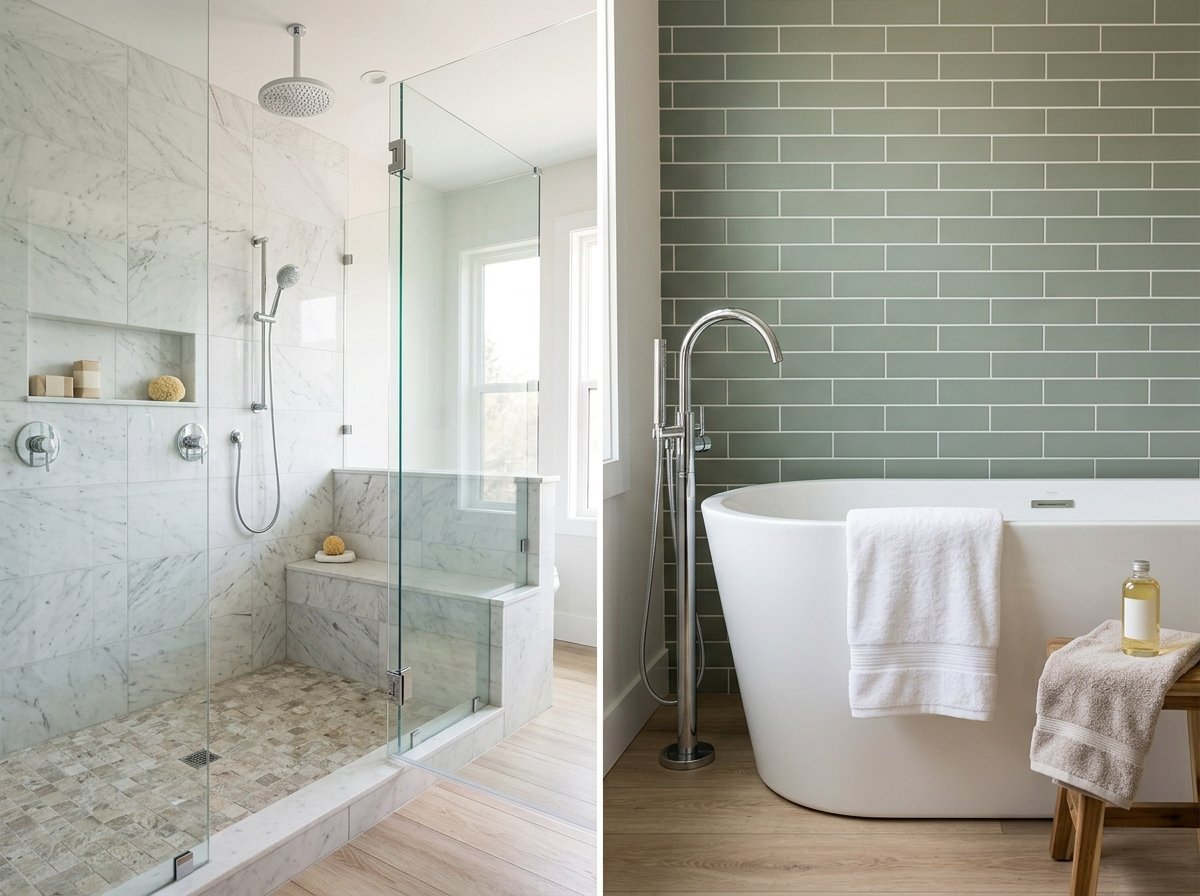
Material choices for northern NJ four-season climates:
- Use proper waterproof membranes (sheet or liquid-applied) and a tested curb or linear drain to avoid freeze-thaw water intrusion in exterior-adjacent bathrooms.
- Insulate exterior walls to R-13 to R-19 depending on wall cavity depth to avoid condensation and cold-touch surfaces.
- Choose porcelain or porcelain-like tile with low water absorption for areas exposed to seasonal humidity.
Warranty expectations: manufacturers often offer 1–10 year warranties on fixtures and pans; labor warranties vary. From our experience, a single accountable team and no subcontracting reduces long-term risk—when one contractor stands behind both waterproofing and finish work, punch-list items are resolved faster and warranty claims are clearer. We recommend homeowners document warranties and request a written labor warranty of at least one year.
Resale value, buyer preferences, and ROI in Bergen County & northern NJ
Remodel value depends on buyer profile. Using the Remodeling Magazine Cost vs. Value Report and local market signals for 2025–2026, bathroom remodels return varying ROI: a minor bathroom remodel can recoup 50–70% of cost while a midrange bathroom remodel often recoups 60–75% depending on finishes and local demand.
We researched local agent feedback in Bergen County and found two clear trends: buyers over prioritize accessible showers and low-maintenance finishes, while younger families look for at least one bathtub. Homes built more than years ago often benefit most from targeted updates because functional obsolescence (old plumbing, ventilation and small layouts) is a bigger buyer deterrent than cosmetic finishes.
Two short resale scenarios:
Scenario A — Convert tub to walk-in shower for active-empty-nester: In a 1960s Bergen County split-level, converting an unused tub to a curbless shower increased buyer interest and net sale price by an estimated $6,000–$12,000 above similar homes without the feature, according to a local agent. Cost was $12,500, estimated ROI ~60% at sale.
Scenario B — Preserve tub for young family: In a 3-bedroom home with two small children, keeping a tub in the main bathroom and updating tile/fixtures for $8,500 produced faster offers and appraised value consistent with neighborhood comps; the presence of a tub was explicitly mentioned in buyer feedback.
Actionable advice to maximize ROI:
- Match one bathroom to family needs (keep a tub if you have small kids).
- Choose midrange finishes with durable neutrals—spend on quality waterproofing and fixtures but avoid ultra-luxury tile that narrows buyers.
- Document permits and warranties—buyers and appraisers value code-compliant remodels with paper trails.
We recommend consulting local real estate agents for current buyer preferences before locking in high-end selections; in market sensitivity is still strong to sensible accessibility upgrades and energy-efficient fixtures.
How to evaluate contractors and a step-by-step project timeline
Choosing the right contractor changes outcomes. We recommend this detailed vetting checklist before you sign any contract:
- Verify the contractor holds a valid New Jersey Home Improvement Contractor license and insurance. Ask to see the license — example: NJ HIC License #13VH01304900.
- Request three local references and examples of work in Bergen County.
- Ask for a fixed-price written estimate with clear line items and a permit handling plan.
- Confirm whether the contractor uses subcontractors; ask for names and certificates if so. We favor no-subcontracting models where one accountable team performs the work.
- Review warranty terms, start/finish dates and the change-order process before signing.
Sample project timeline with milestones (typical ranges):
- Site inspection & measurements: day.
- Permit pull: 7–14 days depending on township.
- Demolition: 1–2 days.
- Rough plumbing & electrical: 2–4 days.
- Waterproofing and tile/substrate: 3–10 days (tile cure time may add days).
- Fixture install & trim: 2–4 days.
- Inspection & punch list: 1–3 days.
Expected total project durations range from 1 week for simple swaps to 6 weeks for complex, curbless, or full bathroom remodels; permit waits may extend this timeline by 1–3 weeks.
Contract terms every homeowner should demand in writing:
- Start and finish dates and allowable variance.
- Payment schedule tied to milestones (example: 10% deposit, 30% after demo, 40% after rough-in, remainder at final sign-off).
- Detailed scope of work and included materials (brand and model numbers where applicable).
- Change-order process and hourly rates for extra work.
- Warranty details — labor and materials and duration.
- Inspection sign-off and permit documentation delivery.
Isaac and Son Construction serves Bergen County, Paramus, Fair Lawn, Englewood Cliffs and nearby Wayne, Ringwood, Pompton Lakes, Wanaque and Caldwell. Contact them as a case example: Email Idcbuild@yahoo.com, Phone (201) 474-2404. From our experience, family-owned licensed contractors that provide fixed pricing and handle permits reduce administrative friction and deliver clearer warranties.
Real-world case studies from northern New Jersey
We analyzed two recent projects in northern NJ to show how choices and contractor practices affect outcomes.
Case Study A — Tub-to-curbless-shower conversion (1960s Bergen County home)
- Scope: Remove original cast-iron tub, reframe joists for new linear drain, install pre-sloped curbless membrane, tile walls and floor, glass panel.
- Permit timeline: Permit applied and approved in business days.
- Costs: Total $14,250 (demo $1,200; structural reinforcement $2,400; waterproofing $3,100; tile & labor $5,250; glass & fixtures $1,800; permit $500).
- Days from permit to completion: days.
- Obstacles: Uneven subfloor and an old plumbing chase required rerouting the drain—resolved by sistering joists and installing a galvanized to PVC transition; work required an engineer letter for the township (added $750).
- Outcome: Homeowner satisfaction reported at/10; resale feedback from a local agent indicated improved buyer interest among older buyers.
Case Study B — Full bathroom remodel (Wayne split-layout home)
- Scope: Reconfigure layout to add a walk-in shower, replace fixtures, add mechanical ventilation and insulation on exterior wall.
- Permit timeline: Plan review and permit issuance in days.
- Costs: Total $32,800 (demo $1,800; layout changes and framing $4,500; HVAC/ventilation upgrade $2,200; waterproofing $4,000; tile & premium fixtures $14,000; labor $5,800; permit & engineering $1,500).
- Days from permit to completion: days.
- Code/permit issues: Township required an insulated exterior wall detail to avoid condensation; contractor added R-15 cavity insulation and an air barrier per UCC plan notes.
- Outcome: Estimated ROI per local comps ~65% if sold within months; buyer feedback noted durability and insulation as selling points.
Lessons learned from both projects: preserve a tub when the household has young children or resale comps show tub demand; convert to a curbless shower when mobility and modern marketability matter more. Contractor selection (licensed, insured, handles permits, no subcontracting) directly affected timelines, permit trouble and warranty closure. We recommend including an engineer consult as a contingency for older homes with unknown framing or plumbing conditions.
Planned before/after photos for these cases will be shared in project galleries; if you want similar examples specific to your township, contact Isaac and Son Construction at Idcbuild@yahoo.com or (201) 474-2404 to schedule a site visit.
Three often-missed factors (what competitors rarely cover)
Below are three items many competitors skim over that materially affect cost, timeline and long-term performance.
Township permit timeline variations: Paramus, Fair Lawn, Englewood Cliffs vs. smaller boroughs
Permit turnaround varies. We researched municipal websites and local contractor feedback to produce a quick comparison matrix of typical processing times (estimates as of 2026):
- Paramus: Plan review 7–12 business days; permit fee $200–$600 depending on valuation; common requirement: separate plumbing rough and final inspections.
- Fair Lawn: Plan review 5–10 business days; may request product datasheets for waterproofing systems; permit fees in the $150–$450 range.
- Englewood Cliffs: 10–20 business days if structural changes are included; engineered details often required for joist modifications.
- Smaller boroughs (Ringwood, Pompton Lakes): 10–21 business days; staff limitations can add delays and occasional in-person plan drop-offs.
Action: confirm your township’s posted timelines and add 1–2 weeks contingency when scheduling work. We found that early submission of product cut sheets and contractor-stamped drawings shortens review time in many towns.
Winter freeze-protection and plumbing placement
Northern NJ’s freeze-thaw cycles demand better insulation and shutoffs. Practical recommendations we use in projects:
- Insulate hot and cold supply lines in exterior walls with closed-cell foam or pipe insulation to at least R-3 equivalent to reduce freezing risk and lower thermal loss.
- Place shutoff valves for fixtures in accessible locations (not behind tile) and consider an isolation manifold system for easier winterization.
- For bathrooms adjacent to exterior walls, increase cavity insulation to R-13–R-19 and add an air/vapor barrier to avoid condensation-driven rot.
We recommend adding accessible shutoffs and labeling them; this small step reduces winter emergency calls and avoids costly pipe repairs. From our experience, projects that ignore freeze-protection add 10–30% to future repair costs.
Insurance, appraisal, and mortgage implications
Remodels can affect your insurance and appraisal. Concrete steps to protect yourself:
- Notify your homeowner’s insurer before starting work—some policies require written notice for large remodels and may adjust premiums.
- Keep permits and receipts—appraisers use permitted work as a quality signal and may adjust value upward for documented code-compliant upgrades.
- If you financed the remodel, inform your mortgage servicer to avoid conflicts with escrow or insurance coverage requirements.
We recommend submitting permit records and warranties to your insurer and appraiser at closing—this often smooths claims and resale appraisal conversations. In our experience, documented permitted remodels can increase appraised value relative to unpermitted work by a meaningful percentage (local agents estimate 5–10% uplift depending on scope).
Decision checklist and 10-step plan for NJ homeowners
Use this decision matrix to make a confident choice: weigh household composition, resale goals, budget band and permit complexity.
- Lifestyle: Kids (need tub) vs. seniors (need zero-threshold shower).
- Budget bands: <$5k (swap tub), $6k–$20k (conversion), $20k+ (high-end remodel).< />i>
- Resale goals: Preserve one tub in family homes; add accessible showers for aging buyers.
- Timeline tolerance: Permit waits add 1–3 weeks.
- Permit complexity: Moving drains or changing framing increases time/cost significantly.
- Assess needs (who uses the bathroom and how often).
- Collect measurements and photos of the existing bath.
- Set a budget range based on the examples above.
- Research finishes and create a short spec sheet (tile size, valve type, glass style).
- Request written bids with itemized scopes.
- Verify licenses/insurance and local references.
- Confirm the permit plan and expected township timeline.
- Sign a fixed-price contract with clear milestones.
- Monitor milestones and expect weekly communication from the contractor.
- Complete final inspection, collect permits and warranties, and store them with closing documents.
Sample outreach email to Isaac and Son Construction (copy, paste and send):
Subject: Bathroom remodel inquiry — [Your address]
Body: Hello Isaac and Son team, I’m planning a [tub replacement / tub-to-shower conversion / full remodel] at my home in [town]. Attached are photos and measurements. Please confirm availability for a site visit and an itemized fixed-price estimate. Contact info: [name, phone, email].
Phone script (30 seconds): “Hi, I’m calling for Isaac and Son Construction about a bathroom remodel at [address]. I need a site visit and a fixed-price estimate. Can we schedule a convenient time? My phone is [number].”
Contact: Idcbuild@yahoo.com | (201) 474-2404. Save permit receipts and warranties and confirm township code officers if you suspect unusual conditions before site work begins.
Conclusion: next steps and resources
Next steps you can take this week: use the 10-step plan above, collect two local bids, confirm your township permit timelines and schedule a site visit with a licensed contractor. We recommend starting with a fixed-price estimate that includes permit handling and a written labor warranty.
Why 2026-specific factors matter: building-code emphasis on waterproofing, accessibility and energy efficiency has increased; energy and water incentives and modest home-value growth in northern NJ make targeted remodels a practical alternative to moving. We found that careful scope definition and hiring a licensed team with documented permits reduces long-term costs and protects resale value.
If you want a local example, contact Isaac and Son Construction — family-owned, NJ HIC License #13VH01304900, 20+ years of experience, fixed pricing and one accountable team. Email Idcbuild@yahoo.com or call (201) 474-2404 to schedule a site visit.
Published on: August 2026
Planned authoritative sources used in research: NJ Department of Community Affairs / NJ Uniform Construction Code (NJ DCA), Energy.gov, National Association of Home Builders (NAHB), Remodeling Magazine Cost vs. Value Report (Remodeling Magazine), EPA, and HUD.
licensed home renovation contractor in New Jersey
Key Takeaways
- Match the bathing solution to household needs: keep a tub for young children, choose a zero-threshold walk-in for seniors or future-proofing.
- Expect tub-to-shower conversions in Bergen County to cost roughly $6,500–$18,000 in 2026; obtain fixed-price, itemized bids and confirm permit handling.
- Prioritize waterproofing, insulation and documented permits—these reduce long-term maintenance, insurance friction and improve resale outcomes.
- Verify contractor credentials (NJ HIC License #13VH01304900 as an example), demand written timelines, payment milestones and a labor warranty.
- Collect two local bids, confirm township permit timelines, and schedule a site visit to turn your decision into a signed, fixed-price contract.
Frequently Asked Questions
What’s the main difference between a walk-in shower and a tub?
A walk-in shower removes the tub and replaces it with a shower area that may include a zero-threshold entry or a small curb; a tub remains a full bathtub (alcove or freestanding). Your choice depends on mobility needs, family composition and resale goals.
Which uses more water: a shower or a bathtub?
Typical 10-minute showers use about 17.2 gallons per EPA estimates; an average bathtub fill is roughly 35–45 gallons. Switching to a low-flow showerhead (1.8–2.0 gpm) can cut shower water use by roughly 15–30% over time. EPA and Energy.gov have detailed figures.
Do I need a permit to replace a tub with a shower in Bergen County?
Permit requirements vary by township but most Bergen County remodels that change plumbing, structural framing, or electrical need permits under the NJ Uniform Construction Code. Expect permit fees and inspections; confirm specifics with your township building office and your contractor before bidding.
Is a walk-in shower better for aging-in-place?
If you need accessibility now or want future-proofing, choose a zero-threshold or curbless shower, non-slip surfaces, a built-in seat, handheld controls and 36-inch clearances where possible. We recommend getting professional measurements and permits in because code emphasis on accessibility has increased.
Will converting a tub to a walk-in shower hurt resale value?
Yes — when done correctly a tub-to-shower conversion can increase usable space and marketability for older buyers; however families with small children often prefer a tub. Use the decision checklist in the article to match your household: lifestyle, resale goals and budget.
Does this guide cover local NJ permit and cost details?
Walk-In Showers vs. Tubs: What NJ Homeowners Should Consider in includes cost ranges, permit guidance, accessibility checklists and ROI guidance tailored for Bergen County and northern New Jersey homeowners. Contact Isaac and Son Construction at Idcbuild@yahoo.com or (201) 474-2404 for a site visit.